

Hush! NASA Funds Exploratory Studies For Quieting Sonic Boom | Aero-News Network
Aero-News Network
RSS icon RSS feed
podcast icon MP3 podcast
Subscribe Aero-News e-mail Newsletter Subscribe

Airborne Unlimited -- Most Recent Daily Episodes

Episode Date

Airborne-Monday

Airborne-Tuesday

Airborne-Wednesday Airborne-Thursday

Airborne-Friday

Airborne On YouTube

Airborne-Unlimited-12.08.25

AirborneNextGen-
12.02.25

Airborne-Unlimited-12.03.25

Airborne-FltTraining-12.04.25

AirborneUnlimited-12.05.25

AFE 2025 LIVE MOSAIC Town Hall (Archived): www.airborne-live.net

Sat, Jul 09, 2005

Hush! NASA Funds Exploratory Studies For Quieting Sonic Boom

Can It Be Done? Consortium Of Manufacturers Bets It Can

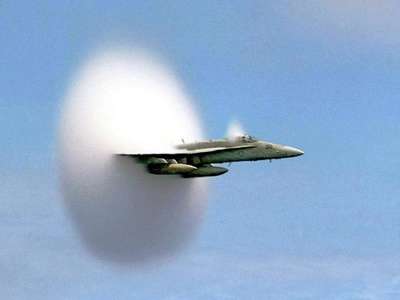
NASA and several industry teams are studying how to design and build an aircraft that could demonstrate technology to lessen the noise and window-rattling effects of supersonic flight.

Preparations for NASA's planned Sonic Boom Mitigation Project include a study of concept feasibility and design requirements for a prototype technology demonstration airplane that could reduce the startling "sonic boom" when an aircraft exceeds the speed of sound.

"NASA plans to develop a request for proposals to design and build a low sonic boom demonstrator using the information provided by the teams," said Bob Meyer, Sonic Boom Mitigation Demonstration Project manager at NASA's Dryden Flight Research Center, Edwards Air Force Base, CA.

NASA awarded a grant to American Technology Alliances (AmTech) to fund these studies being conducted by four industry teams. The teams include solo endeavors by Boeing Phantom Works, of Long Beach, CA. and Raytheon Aircraft in Wichita, KS. Northrop Grumman, El Segundo, CA, is working with Gulfstream Aerospace, Savannah, GA; and Lockheed Martin, Palmdale, CA, has teamed with Cessna Aircraft Company, Wichita, KS.

The same grant is also funding Allison Advanced Development Company, Indianapolis; GE Transportation, Cincinnati; and Pratt and Whitney, Hartford, CT, to support the teams with engine-related data.

Each team has been awarded approximately one million dollars for a five-month study. NASA will use the results to define technology and design requirements for a low sonic boom demonstration aircraft. The questions the research will answer include whether it's feasible to modify an existing aircraft to be the quiet boom demonstrator, or whether a whole new aircraft design will have to be created.

"The concept exploration studies are crucial," said Peter Coen, of the Langley Research Center at Hampton, VA, and a member of the Sonic Boom Mitigation Project planning team. "Those studies will determine whether a low sonic boom demonstrator aircraft can be built at an affordable cost in a reasonable amount of time."

The Sonic Boom Mitigation Project could begin work on the research aircraft as early as this fall.

"It is one element of a transformed Vehicle Systems Program in which breakthrough technologies are carried forward to flight," said Rich Wlezien, manager of the Vehicle Systems Program in NASA's Aeronautics Research Mission Directorate programs.

FMI: www.aeronautics.nasa.gov/vsp

Advertisement

More News

NTSB Final Report: Patriot Aircraft LLC CX1900A

After Draining Both Wing Fuel Tanks, A Significant Amount Of Water Was Observed In The Right Wing Fuel Tank Analysis: The pilot, who was also the owner of the experimental amateur->[...]

Aero-News: Quote of the Day (12.06.25)

“Airbus apologises for any challenges and delays caused to passengers and airlines by this event. The Company thanks its customers, the authorities, its employees and all rel>[...]

ANN's Daily Aero-Term (12.06.25): High Speed Taxiway

High Speed Taxiway A long radius taxiway designed and provided with lighting or marking to define the path of aircraft, traveling at high speed (up to 60 knots), from the runway ce>[...]

ANN's Daily Aero-Linx (12.06.25)

Aero Linx: Taylorcraft Foundation, Inc. The Taylorcraft Foundation is exclusively organized for charitable, educational & scientific activities and will preserve the history an>[...]

Airborne-NextGen 12.02.25: Honda eVTOL, Arctus High-Alt UAS, Samson Patent

Also: USAF Reaper Accident, Baikonur Damage, Horizon eVTOL IFR/FIKI, New Glenn Update Honda has outlined its clearest timeline yet for its entry into the world of electric vertical>[...]

blog comments powered by Disqus



Advertisement

Advertisement

Podcasts

Advertisement

© 2007 - 2025 Web Development & Design by Pauli Systems, LC

