
First GTF PW1900G Production Engines For Embraer E195-E2 Program Delivered | Aero-News Network
Aero-News Network
RSS icon RSS feed
podcast icon MP3 podcast
Subscribe Aero-News e-mail Newsletter Subscribe

Airborne Unlimited -- Most Recent Daily Episodes

Episode Date

Airborne-Monday

Airborne-Tuesday

Airborne-Wednesday Airborne-Thursday

Airborne-Friday

Airborne On YouTube

Airborne-SpecialEpisode-12.15.25

AirborneNextGen-
12.16.25

Airborne-Unlimited-12.10.25

Airborne-AffordableFlyers-12.11.25

AirborneUnlimited-12.12.25

AFE 2025 LIVE MOSAIC Town Hall (Archived): www.airborne-live.net

Fri, Feb 22, 2019

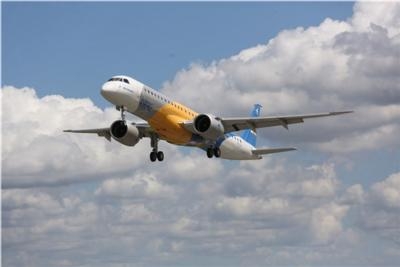
First GTF PW1900G Production Engines For Embraer E195-E2 Program Delivered

Airplane Is Expected To Enter Into Service Later This Year

Embraer has taken delivery of the first Pratt & Whitney GTF PW1900G production engines for the E195-E2 aircraft at Embraer's E2 final assembly line in São José dos Campos, São Paulo, Brazil. The E195-E2 is expected to enter into service in the second half of 2019 with Azul Brazilian Airlines.

"We are excited to receive the GTF production engines for the initial serial production of the E195-E2, as we know firsthand the advantages that these engines provide to our customers and the environment," said Fernando Antonio Oliveira, Embraer's E2 Program Director.

Embraer's E190-E2 aircraft, which is also powered by the Pratt & Whitney PW1900G engine, entered service in April 2018 with Widerøe, followed by Air Astana in December 2018.

"Delivering the first production engines for the E195-E2 is an important milestone for the program," said Graham Webb, vice president of Commercial Engine Programs at Pratt & Whitney. "We look forward to continuing to work together to support Embraer's second GTF-powered E2 aircraft model."

In addition to being selected as the exclusive propulsion system for the E2 commercial aircraft, Pratt & Whitney's APS2600E auxiliary power unit (APU) is the sole-sourced APU for the E2 family. The APS2600E APU gives airlines greater flexibility, by increasing the altitude ceiling for ETOPS and other operations, and providing a significant increase in electrical power delivery to meet the needs of today's airlines.

The E195-E2 aircraft has more than 24% reduction in fuel burn per seat than the previous-generation E195, with NOx emissions 50% below the ICAO CAEP/6 regulation and 19dB to 20dB of ICAO Chapter 4 cumulative noise margin.

(Souce: Pratt & Whitney news release. Image from file)

FMI: www.pratt-whitney.com

Advertisement

More News

Aero-News: Quote of the Day (12.18.25)

“These new aircraft strengthen our ability to respond quickly, train effectively and support communities nationwide. Textron Aviation has been a steadfast supporter in helpin>[...]

Classic Aero-TV: Viking Twin Otter 400--Bringing the DHC-6 Back Into Production

From 2011 (YouTube Edition): Rugged, Legendary, STOL Twin Makes A Comeback The de Havilland Twin Otter is an airplane with a long history, and it gained a reputation as a workhorse>[...]

NTSB Final Report: Rans Employee Flying Club Rans S-6ES Coyote II

A Wind Gust Lifted The Right Wing And The Airplane Turned To The Left Analysis: The pilot was departing from a 2,395-ft-long by 50-ft-wide turf runway. The pilot reported that afte>[...]

ANN FAQ: Submit a News Story!

Have A Story That NEEDS To Be Featured On Aero-News? Here’s How To Submit A Story To Our Team Some of the greatest new stories ANN has ever covered have been submitted by our>[...]

ANN's Daily Aero-Term (12.18.25): Braking Action Advisories

Braking Action Advisories When tower controllers receive runway braking action reports which include the terms “medium," “poor," or “nil," or whenever weather con>[...]

blog comments powered by Disqus



Advertisement

Advertisement

Podcasts

Advertisement

© 2007 - 2025 Web Development & Design by Pauli Systems, LC

