
NASA To Demonstrate Sonic 'Thump' Compared To Standard Sonic Boom | Aero-News Network
Aero-News Network
RSS icon RSS feed
podcast icon MP3 podcast
Subscribe Aero-News e-mail Newsletter Subscribe

Airborne Unlimited -- Most Recent Daily Episodes

Episode Date

Airborne-Monday

Airborne-Tuesday

Airborne-Wednesday Airborne-Thursday

Airborne-Friday

Airborne On YouTube

Airborne-Unlimited-12.01.25

AirborneNextGen-
12.02.25

Airborne-Unlimited-12.03.25

Airborne-FltTraining-12.04.25

AirborneUnlimited-12.05.25

AFE 2025 LIVE MOSAIC Town Hall (Archived): www.airborne-live.net

Mon, May 23, 2016

NASA To Demonstrate Sonic 'Thump' Compared To Standard Sonic Boom

Event To Take Place May 31 At Armstrong Flight Research Center

NASA is planning a comparative demonstration of the currently louder sonic boom to a quieter, more community-friendly sonic "thump", which NASA looks to achieve through an experimental aircraft for Quiet Supersonic Technology (QueSST).

The May 31 event beginning at 9:00 a.m. PDT will be held at NASA's Armstrong Flight Research Center in Edwards, California, where manned supersonic flight was first achieved in 1947.

The event will feature supersonic flyovers by a NASA F/A-18 'Hornet' aircraft. The jet will produce a conventional, largely audible sonic boom, followed by another pass, in which it will perform a special dive maneuver, demonstrating a quieter "thump" in place of the boom. The quieter thump is closely similar to what NASA engineers believe supersonic flight may sound like through QueSST.

The disruptive sonic boom is the primary cause for the FAA's restriction on supersonic flight over land. NASA's efforts in QueSST may open the future to supersonic aviation on a commercial level.

In addition to the supersonic demonstration, NASA will feature presentations from Commercial Supersonic Technology program managers.

Following the supersonic portion of the event, NASA Armstrong will then showcase current efforts to safely integrate Unmanned Aircraft Systems into the National Airspace System (UAS-NAS).

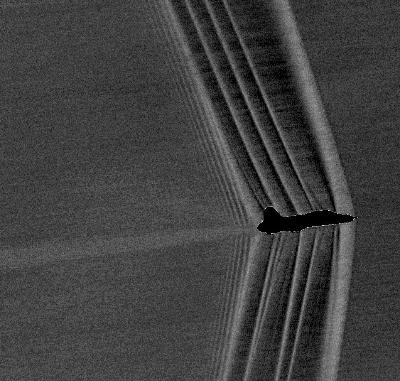
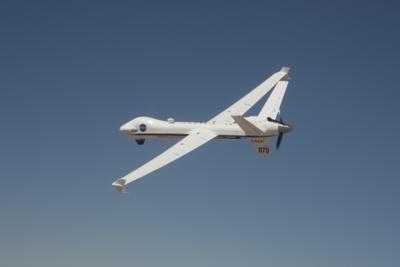
(Images provided with NASA news release. Top: Shockwaves produced by a U.S. Air Force Test Pilot School T-38 aircraft in supersonic flight are captured by NASA researchers using a special filter and camera on the ground. Bottom: NASA's Ikhana is being used for the development of regulations to integrate Unmanned Aircraft Systems in the National Airspace System)

FMI: www.nasa.gov/centers/armstrong

Advertisement

More News

Classic Aero-TV: VerdeGo Debuts VH-3 Hybrid-Electric Powerplant

From 2023 (YouTube Edition): New Propulsion Scheme Optimized for AAM Applications Founded in 2017 by Eric Bartsch, Pat Anderson, and Erik Lindbergh (grandson of famed aviation pion>[...]

NTSB Prelim: Grumman American Avn. Corp. AA-5B

During The Initial Climb, The Engine Began To Operate Abnormally And, After About Three Seconds, Experienced A Total Loss Of Power On October 29, 2025, about 1820 Pacific daylight >[...]

ANN's Daily Aero-Linx (12.02.25)

Aero Linx: Women in Aviation International Women in Aviation International is the largest nonprofit organization that envisions a world where the sky is open to all, and where avia>[...]

Aero-News: Quote of the Day (12.02.25)

“We’ve paid for the cable line’s repair for the customer and have apologized for the inconvenience this caused them...” Source: Some followup info from an A>[...]

Aero-News: Quote of the Day (12.03.25)

“We have long warned about the devastating effects of pairing optimization. Multiple times over many months, we highlighted how schedule manipulation, unbalanced schedules, a>[...]

blog comments powered by Disqus



Advertisement

Advertisement

Podcasts

Advertisement

© 2007 - 2025 Web Development & Design by Pauli Systems, LC

