Debris Not Expected To Reach Earth
The missile fired from a US Navy ship in the Pacific Ocean that
hit a malfunctioning US reconnaissance satellite late yesterday
likely accomplished its goal of destroying the satellite's toxic
fuel tank, a senior US military officer said Thursday.
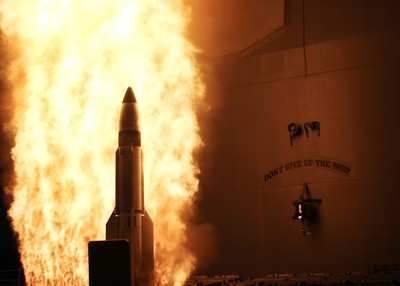
Preliminary reports indicate the SM-3 missile struck its primary
target, which was a tank full of toxic hydrazine rocket fuel
carried aboard the 5,000-pound satellite, Marine Gen. James E.
Cartwright, vice chairman of the Joint Chiefs of Staff, told
reporters at a Pentagon news conference.
"The intercept occurred. ... We're very confident that we hit
the satellite," Cartwright said. "We also have a high degree of
confidence that we got the tank."
Video shown to reporters depicts the satellite exploding at the
point of contact with the missile. Cartwright said the visible
fireball and the vapor cloud or plume around it suggest that the
fuel tank was hit and the hydrazine had burned up.
 "The high-definition imagery that we
have indicates that we hit the spacecraft right in the area of the
tank," Cartwright said.
"The high-definition imagery that we
have indicates that we hit the spacecraft right in the area of the
tank," Cartwright said.
However, he added, it probably would take another 24 to 48 hours
of sifting through data "to get to a point where we are very
comfortable with our analysis that we indeed breached the
tank."
Radar sweeps of the satellite's debris field thus far show that
no parts larger than a football survived the strike, Cartwright
said. Post-strike surveillance shows satellite debris falling into
the atmosphere above the Atlantic and Pacific Oceans, he said.
Small remnants are likely to burn up in the atmosphere, never
making it to the Earth's surface.
The US State Department has provided updates on the situation to
its embassies around the world, Cartwright noted. There are no
reports of debris reaching the Earth, he said, adding that
consequence-management crews are on standby to respond to such a
circumstance, if required.
The SM-3 missile was launched by the USS Lake Erie, positioned
northwest of Hawaii, at 10:26 pm EST Wednesday, Cartwright said.
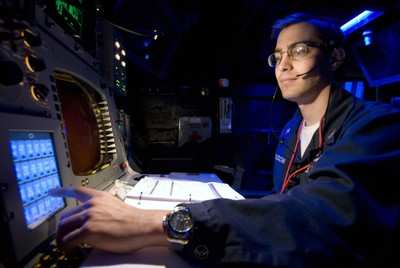
Fire Controlman 2nd Class Andrew Jackson (shown below), a native of
Ray Town, MO launched the missile from the Combat Information
Center aboard the Ticonderoga-class guided missile cruiser USS Lake
Erie (CG 70).
Defense Secretary Robert M. Gates, who is on an overseas trip,
gave the go-ahead to fire, Cartwright said.
The missile intercepted the satellite about 153 nautical miles
above the Earth, just before it began to enter the atmosphere,
Cartwright said. Joint Space Operations Center technicians at
Vandenberg Air Force Base, CA confirmed the satelitte's breakup
about 24 minutes later.
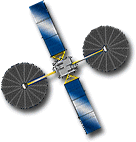
The National Reconnaissance Office-managed satellite
malfunctioned soon after it was launched in 2006, making it
unresponsive to ground control. The satellite, orbiting Earth every
90 minutes or so, was expected to fall to Earth in February or
March with its tank of hydrazine intact, possibly endangering human
populations.
President Bush directed the Defense Department to engage the
satellite just before it entered the atmosphere. U.S. officials
decided to shoot down the satellite because of the danger posed by
the hazardous hydrazine, Cartwright explained, noting the goal was
for the missile to hit and rupture the tank of rocket fuel, causing
the hydrazine to burn up harmlessly in the atmosphere, along with
debris from the stricken satellite.
"So, you can imagine at the point of intercept last night there
were a few cheers from people who have spent many days working on
this project," Cartwright said.
(Aero-News thanks Gerry J. Gilmore, American Forces Press
Service)



 ANN's Daily Aero-Term (12.19.25): Ultrahigh Frequency (UHF)


 See All