
Canadian TSB Releases Report From August, 2013 Helicopter Accident | Aero-News Network
Aero-News Network
RSS icon RSS feed
podcast icon MP3 podcast
Subscribe Aero-News e-mail Newsletter Subscribe

Airborne Unlimited -- Most Recent Daily Episodes

Episode Date

Airborne-Monday

Airborne-Tuesday

Airborne-Wednesday Airborne-Thursday

Airborne-Friday

Airborne On YouTube

Airborne-Unlimited-12.08.25

AirborneNextGen-
12.02.25

Airborne-Unlimited-12.03.25

Airborne-FltTraining-12.04.25

AirborneUnlimited-12.05.25

AFE 2025 LIVE MOSAIC Town Hall (Archived): www.airborne-live.net

Fri, Jan 09, 2015

Canadian TSB Releases Report From August, 2013 Helicopter Accident

Finds Manufacturing Anomalies Led To Engine Power Loss Near Bella Coola, British Columbia

In its investigation report (A13P0163) released Wednesday, the Transportation Safety Board of Canada (TSB) found that a Kamov Ka-32 helicopter operated by VIH Helicopters Ltd. suffered an engine power loss due to anomalies in engine components that were not detected by quality control during engine manufacture and assembly.

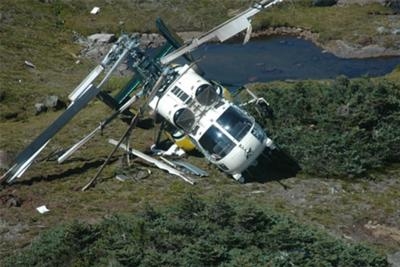
On 4 August 2013, a Kamov Ka-32 helicopter was carrying out forest fire suppression operations near Bella Coola, British Columbia using a water bucket on a long line. Just as the helicopter lifted a load of water out of a lake, there was a series of unusual sounds and the aircraft began to shake severely. The pilot not flying released the water bucket, and the pilot flying flew towards land for an emergency landing. The crew experienced difficulties controlling the aircraft on the way to the intended landing area. The helicopter touched down while drifting sideways to the right, and subsequently bounced and rolled onto its right side. The crew, who suffered minor injuries, shut down the engines and exited the helicopter without difficulties. There was no fire.

The investigation found that compressor turbine components failed due to manufacturing anomalies, causing the engine to lose power. Quality control during the manufacture and assembly of the engine's compressor turbine section did not identify the anomalies in the components, which were visible to the naked eye. If poor quality control is systemic, helicopters with these engines (Klimov TV3-117) are at risk of failure, which can have serious consequences for aircraft, crew, and passengers.

Following the occurrence, the Russian aviation regulator issued a revised airworthiness directive that increased maintenance requirements for engines installed in Kamov Ka-32 helicopters used for external load operations.

(Image included in final report)

FMI: www.tsb.gc.ca

Advertisement

More News

NTSB Final Report: Patriot Aircraft LLC CX1900A

After Draining Both Wing Fuel Tanks, A Significant Amount Of Water Was Observed In The Right Wing Fuel Tank Analysis: The pilot, who was also the owner of the experimental amateur->[...]

Aero-News: Quote of the Day (12.06.25)

“Airbus apologises for any challenges and delays caused to passengers and airlines by this event. The Company thanks its customers, the authorities, its employees and all rel>[...]

ANN's Daily Aero-Term (12.06.25): High Speed Taxiway

High Speed Taxiway A long radius taxiway designed and provided with lighting or marking to define the path of aircraft, traveling at high speed (up to 60 knots), from the runway ce>[...]

ANN's Daily Aero-Linx (12.06.25)

Aero Linx: Taylorcraft Foundation, Inc. The Taylorcraft Foundation is exclusively organized for charitable, educational & scientific activities and will preserve the history an>[...]

Airborne-NextGen 12.02.25: Honda eVTOL, Arctus High-Alt UAS, Samson Patent

Also: USAF Reaper Accident, Baikonur Damage, Horizon eVTOL IFR/FIKI, New Glenn Update Honda has outlined its clearest timeline yet for its entry into the world of electric vertical>[...]

blog comments powered by Disqus



Advertisement

Advertisement

Podcasts

Advertisement

© 2007 - 2025 Web Development & Design by Pauli Systems, LC

