
Lockheed Martin, USAF Test Pilot School Conduct Successful F-16 Autolanding | Aero-News Network
Aero-News Network
RSS icon RSS feed
podcast icon MP3 podcast
Subscribe Aero-News e-mail Newsletter Subscribe

Airborne Unlimited -- Most Recent Daily Episodes

Episode Date

Airborne-Monday

Airborne-Tuesday

Airborne-Wednesday Airborne-Thursday

Airborne-Friday

Airborne On YouTube

Airborne-Unlimited-12.08.25

AirborneNextGen-
12.02.25

Airborne-Unlimited-12.03.25

Airborne-FltTraining-12.04.25

AirborneUnlimited-12.05.25

AFE 2025 LIVE MOSAIC Town Hall (Archived): www.airborne-live.net

Wed, Dec 10, 2008

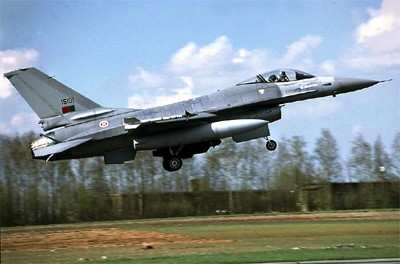
Lockheed Martin, USAF Test Pilot School Conduct Successful F-16 Autolanding

Uses Computer Algorithms To Control Fighter From Approach To Ground Stop

There's a saying among "Viper" pilots -- they don't fly the F-16, as much as the F-16 flies them. They may now add "and it brings us back to Earth, too" to that axiom.

Lockheed Martin and the US Air Force Test Pilot School at Edwards Air Force Base, CA have successfully demonstrated an autonomous landing of the F-16 Fighting Falcon, marking the first time an F-16 has landed entirely under computer control.

The successful Autoland demonstration lays the foundation for consistent, repeatable and controlled automatic landings of the F-16 in various wind conditions and airfield situations. Lockheed Martin notes its technology has broad applications for both manned and unmanned aircraft.

"The demonstration of an autonomous landing of an F-16 is evidence that Lockheed Martin is prepared to successfully implement autonomous control of Unmanned Combat Air Vehicle (UCAV)-type aircraft," said Frank Cappuccio, Lockheed Martin's executive vice president and general manager of Advanced Development Programs and Strategic Planning. "Such technology, in concert with the skill and experience of today's warfighter, presents a formidable force against existing foes and provides a basis for further developing manned and unmanned vehicles that can meet the challenges facing the warfighters of tomorrow," he said.

The Autoland sequence is initiated during flight by an on-board safety pilot. Once the pilot moves to "hands-off" the aircraft controls, the F-16 is controlled by an onboard computer and guided through several phases of the landing sequence, culminating in a final approach to the runway touchdown point. The computer uses Lockheed Martin-developed algorithms to control the F-16's attitude, glide slope, airspeed, and descent rate via throttle and flight control inputs until the aircraft comes to a stop on the runway.

The USAF Test Pilot School provided full flight test resources for the demonstration, including the VISTA/F-16 (Variable Stability In-flight Simulator Test Aircraft), Calspan Corporation flight test safety pilots (under contract to the Test Pilot School), and testbed support and facilities. Lockheed Martin Aeronautics and the USAF Test Pilot School performed all activities in full partnership, from initial planning through implementation and test execution.

FMI: www.lockheedmartin.com, www.edwards.af.mil/library/factsheets/factsheet.asp?id=6467

Advertisement

More News

NTSB Final Report: Patriot Aircraft LLC CX1900A

After Draining Both Wing Fuel Tanks, A Significant Amount Of Water Was Observed In The Right Wing Fuel Tank Analysis: The pilot, who was also the owner of the experimental amateur->[...]

Aero-News: Quote of the Day (12.06.25)

“Airbus apologises for any challenges and delays caused to passengers and airlines by this event. The Company thanks its customers, the authorities, its employees and all rel>[...]

ANN's Daily Aero-Term (12.06.25): High Speed Taxiway

High Speed Taxiway A long radius taxiway designed and provided with lighting or marking to define the path of aircraft, traveling at high speed (up to 60 knots), from the runway ce>[...]

ANN's Daily Aero-Linx (12.06.25)

Aero Linx: Taylorcraft Foundation, Inc. The Taylorcraft Foundation is exclusively organized for charitable, educational & scientific activities and will preserve the history an>[...]

Airborne-NextGen 12.02.25: Honda eVTOL, Arctus High-Alt UAS, Samson Patent

Also: USAF Reaper Accident, Baikonur Damage, Horizon eVTOL IFR/FIKI, New Glenn Update Honda has outlined its clearest timeline yet for its entry into the world of electric vertical>[...]

blog comments powered by Disqus



Advertisement

Advertisement

Podcasts

Advertisement

© 2007 - 2025 Web Development & Design by Pauli Systems, LC

