Thu, Dec 05, 2013
Comet Now 'Likely Only Dust' After Close Encounter With The Sun
After several days of continued observations, scientists continue to work to determine and to understand the fate of Comet ISON: There's no doubt that the comet shrank in size considerably as it rounded the sun and there's no doubt that something made it out on the other side to shoot back into space. The question remains as to whether the bright spot seen moving away from the sun was simply debris, or whether a small nucleus of the original ball of ice was still there. Regardless, it is likely that it is now only dust.
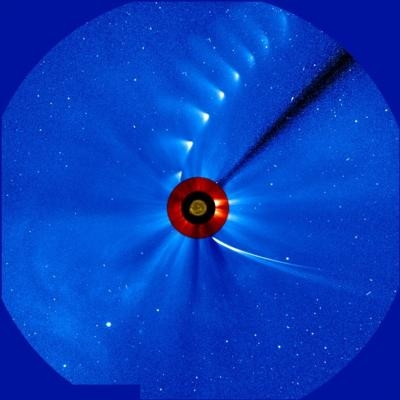
Comet ISON, which began its journey from the Oort Cloud some 3 million years ago, made its closest approach to the sun on Nov. 28, 2013. The comet was visible in instruments on NASA's Solar Terrestrial Relations Observatory, or STEREO, and the joint European Space Agency/NASA Solar and Heliospheric Observatory, or SOHO, via images called coronagraphs. Coronagraphs block out the sun and a considerable distance around it, in order to better observe the dim structures in the sun's atmosphere, the corona. As such, there was a period of several hours when the comet was obscured in these images, blocked from view along with the sun. During this period of time, NASA's Solar Dynamics Observatory could not see the comet, leading many scientists to surmise that the comet had disintegrated completely. However, something did reappear in SOHO and STEREO coronagraphs some time later – though it was significantly less bright.
Whether that spot of light was merely a cloud of dust that once was a comet, or if it still had a nucleus – a small ball of its original, icy material – intact, is still unclear. It seems likely that as of Dec. 1, there was no nucleus left. By monitoring its changes in brightness over time, scientists can estimate whether there's a nucleus or not, but our best chance at knowing for sure will be if the Hubble Space Telescope makes observations later in December 2013.
Regardless of its fate, Comet ISON did not disappoint researchers. Over the last year, observatories around the world and in space gathered one of the largest sets of comet observations of all time, which should provide fodder for study for years to come. The number of space-based, ground-based, and amateur observations were unprecedented, with twelve NASA space-based assets observing over the past year.
(Image provided by NASA)
More News
Convective SIGMET A weather advisory concerning convective weather significant to the safety of all aircraft. Convective SIGMETs are issued for tornadoes, lines of thunderstorms, e>[...]
Aero Linx: United Flying Octogenarians WELCOME to a most extraordinary group of aviators, the United Flying Octogenarians (UFO). Founded in 1982 with just a handful of pilots, we h>[...]
Pilot’s Decision To Attempt Takeoff With Frost Covering The Airplane’s Wings Analysis: The pilot of the light sport airplane was preparing to depart for a cross-country>[...]
“We’ve paid for the cable line’s repair for the customer and have apologized for the inconvenience this caused them...” Source: Some followup info from an A>[...]
Coupled Approach An instrument approach performed by the aircraft autopilot, and/or visually depicted on the flight director, which is receiving position information and/or steerin>[...]



 ANN's Daily Aero-Term (12.01.25): Convective SIGMET


 See All