

ZeroAvia Gets USAF Grant For Autonomous Hybrid Aircraft | Aero-News Network
Aero-News Network
RSS icon RSS feed
podcast icon MP3 podcast
Subscribe Aero-News e-mail Newsletter Subscribe

Airborne Unlimited -- Most Recent Daily Episodes

Episode Date

Airborne-Monday

Airborne-Tuesday

Airborne-Wednesday Airborne-Thursday

Airborne-Friday

Airborne On YouTube

Airborne-Unlimited-11.24.25

AirborneNextGen-
11.18.25

Airborne-Unlimited-11.19.25

Airborne-AffordableFlyers-11.20.25

AirborneUnlimited-11.21.25

LIVE MOSAIC Town Hall (Archived): www.airborne-live.net

Sun, Mar 30, 2025

ZeroAvia Gets USAF Grant For Autonomous Hybrid Aircraft

Integrating Hydrogen-Electric Propulsion Into Autonomous Cessna Caravan

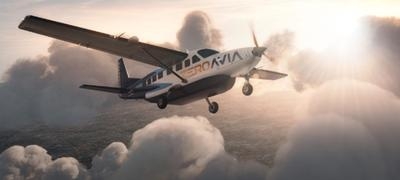
ZeroAvia announced it has been selected for a Small Business Innovation Research (SBIR) grant by AFWERX to conduct a feasibility study for integrating hydrogen propulsion into Cessna Caravan in conjunction with autonomous technology. The AFWERX grants are awarded to promote research into questions that address challenges facing the Department of the Air Force.

The ZeroAvia grant will enable the company to analyze the potential for development of an 8,000 pound autonomous aircraft with hydrogen propulsion that will have reduced engine noise and a low thermal signature to significantly reduce its detectability.

Hydrogen fuel cells are currently under research by a number of academic and commercial interests and appear to be a promising technology for improving the range, duration, and turnaround time of electric UAVs.

As an aviation fuel, hydrogen has advantages in that it can be produced without the need for extensive infrastructure or transportation: It can be produced on-site where there is a ready supply of water and electricity. This significantly reduces the logistics of fueling which is a critical consideration in any military or defense application.

In addition, hydrogen has the highest energy per unit of weight of any chemical energy source. This enables a potential maximum range of more than 2,000 nm (4,000 km) in an autonomous aircraft of this type.

ZeroAvia is furthering the certification of a 600 kW hydrogen-electric powertrain, the ZA600, which uses fuel cells to convert hydrogen fuel into electricity to power the electric motors. The company’s first airframe for integrating the powertrain is the Textron-manufactured Cessna Caravan.

Reliable Robotics is a California company specializing in remote operation of aircraft and will be supporting the project by exploring potential relevant autonomous flight systems.

FMI:  zeroavia.com/

Advertisement

More News

Classic Aero-TV: Extra; the Airplane, the Man, and His Grand DeLand Plan

From 2023 (YouTube Edition): Germany’s Best by Way of Florida Established in 1980 by German aerobatic pilot Walter Extra as a means by which to design and develop his own air>[...]

ANN FAQ: Follow Us On Instagram!

Get The Latest in Aviation News NOW on Instagram Are you on Instagram yet? It's been around for a few years, quietly picking up traction mostly thanks to everybody's new obsession >[...]

Aero-News: Quote of the Day (11.27.25)

“Achieving PMA for the S-1200 Series magnetos is another step in expanding our commitment to providing the aviation community with the most trusted and durable ‘firewal>[...]

ANN's Daily Aero-Term (11.27.25): Ultralight Vehicle

Ultralight Vehicle A single-occupant aeronautical vehicle operated for sport or recreational purposes which does not require FAA registration, an airworthiness certificate, or pilo>[...]

ANN's Daily Aero-Linx (11.27.25)

Aero Linx: The de Havilland Moth Club Ltd The de Havilland Moth Club evolved from a belief that an association of owners and operators of Moth aeroplanes should be formed to create>[...]

blog comments powered by Disqus



Advertisement

Advertisement

Podcasts

Advertisement

© 2007 - 2025 Web Development & Design by Pauli Systems, LC

