
Mars Rover's Laser-Zapping Instrument Gets Sharper Vision | Aero-News Network
Aero-News Network
RSS icon RSS feed
podcast icon MP3 podcast
Subscribe Aero-News e-mail Newsletter Subscribe

Airborne Unlimited -- Most Recent Daily Episodes

Episode Date

Airborne-Monday

Airborne-Tuesday

Airborne-Wednesday Airborne-Thursday

Airborne-Friday

Airborne On YouTube

Airborne-Unlimited-11.24.25

AirborneNextGen-
11.18.25

Airborne-Unlimited-11.19.25

Airborne-AffordableFlyers-11.20.25

AirborneUnlimited-11.21.25

LIVE MOSAIC Town Hall (Archived): www.airborne-live.net

Mon, Jun 01, 2015

Mars Rover's Laser-Zapping Instrument Gets Sharper Vision

Auto-Focus Became Inoperative Several Months Ago, NASA Says

Tests on Mars have confirmed success of a repair to the autonomous focusing capability of the Chemistry and Camera (ChemCam) instrument on NASA's Curiosity Mars rover.

This instrument provides information about the chemical composition of targets by zapping them with laser pulses and taking spectrometer readings of the induced sparks. It also takes detailed images through a telescope.

Work by the instrument's team members at Los Alamos National Laboratory in New Mexico and in France has yielded an alternative auto-focus method following loss of use of a small laser that served for focusing the instrument during Curiosity's first two years on Mars.

"Without this laser rangefinder, the ChemCam instrument was somewhat blind," said Roger Wiens, ChemCam principal investigator at Los Alamos. "The main laser that creates flashes of plasma when it analyzes rocks and soils up to 25 feet from the rover was not affected, but the laser analyses only work when the telescope projecting the laser light to the target is in focus."

For the past several months, the team has coped without auto-focusing. For each target, the instrument has taken multiple images or multiple laser analyses at different focal distances. The data were sent to Earth for selection of the in-focus image or laser analysis among the set.

The repair required sending new software to be installed on the instrument. It now takes multiple images and uses those to autonomously select the focus positions for the final images and laser analyses sent back to Earth.

"We think we will actually have better quality images and analyses with this new software than the original," said Wiens.

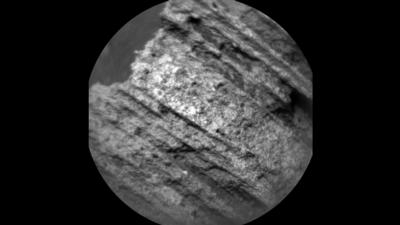
(Image provided by NASA. This May 15, 2015, image from the Chemistry and Camera (ChemCam) instrument on NASA's Curiosity Mars rover shows detailed texture of a rock target called "Yellowjacket" on Mars' Mount Sharp. This was the first rock target for ChemCam after checkout of restored capability for autonomous focusing.)

FMI: www.nasa.gov/msl

Advertisement

More News

Classic Aero-TV: Extra; the Airplane, the Man, and His Grand DeLand Plan

From 2023 (YouTube Edition): Germany’s Best by Way of Florida Established in 1980 by German aerobatic pilot Walter Extra as a means by which to design and develop his own air>[...]

ANN FAQ: Follow Us On Instagram!

Get The Latest in Aviation News NOW on Instagram Are you on Instagram yet? It's been around for a few years, quietly picking up traction mostly thanks to everybody's new obsession >[...]

Aero-News: Quote of the Day (11.27.25)

“Achieving PMA for the S-1200 Series magnetos is another step in expanding our commitment to providing the aviation community with the most trusted and durable ‘firewal>[...]

ANN's Daily Aero-Term (11.27.25): Ultralight Vehicle

Ultralight Vehicle A single-occupant aeronautical vehicle operated for sport or recreational purposes which does not require FAA registration, an airworthiness certificate, or pilo>[...]

ANN's Daily Aero-Linx (11.27.25)

Aero Linx: The de Havilland Moth Club Ltd The de Havilland Moth Club evolved from a belief that an association of owners and operators of Moth aeroplanes should be formed to create>[...]

blog comments powered by Disqus



Advertisement

Advertisement

Podcasts

Advertisement

© 2007 - 2025 Web Development & Design by Pauli Systems, LC

