
Processing Of PRISMA Begins For Arianespace's Next Vega Launch | Aero-News Network
Aero-News Network
RSS icon RSS feed
podcast icon MP3 podcast
Subscribe Aero-News e-mail Newsletter Subscribe

Airborne Unlimited -- Most Recent Daily Episodes

Episode Date

Airborne-Monday

Airborne-Tuesday

Airborne-Wednesday Airborne-Thursday

Airborne-Friday

Airborne On YouTube

Airborne-Unlimited-11.24.25

AirborneNextGen-
11.18.25

Airborne-Unlimited-11.19.25

Airborne-AffordableFlyers-11.20.25

AirborneUnlimited-11.21.25

LIVE MOSAIC Town Hall (Archived): www.airborne-live.net

Wed, Jan 30, 2019

Processing Of PRISMA Begins For Arianespace's Next Vega Launch

Will Be First Vega Mission For 2019 From The Spaceport

Payload preparations have commenced for Arianespace’s first Vega mission in 2019, which will deliver the Italian Space Agency’s (ASI) newest Earth observation satellite to Sun-synchronous orbit in March.

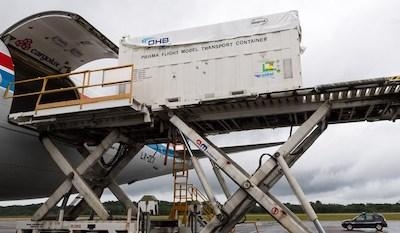
Built by OHB Italia as system prime contractor, PRISMA (PRecursore IperSpettrale della Missione Applicativa) was transported to French Guiana aboard a chartered 747 cargo aircraft – touching down at Félix Eboué Airport earlier this month, then travelling by road to the Spaceport to begin processing.

PRISMA is fitted with an innovative electro-optical instrument combining a hyperspectral sensor with a medium-resolution panchromatic camera. This type of combined instrument offers the advantages of conventional observation (based on the recognition of geometric characteristics of a scene) coupled with the ability to determine the chemical and physical characteristics of the objects present in the scene, using the hyperspectral sensor.

The scientific community and other users will be able to employ these capabilities for a wide range of applications, including – but not limited to – environmental monitoring, resource management, identification and classification of crops, and the efforts to limit pollution.

The March mission with PRISMA is designated Flight VV14, signifying the 14th launch of the lightweight Vega – which joins Arianespace’s medium-lift Soyuz and heavyweight Ariane 5 in a complete launch vehicle family to orbit commercial, governmental, institutional, scientific and experimental payloads.

The company’s fast-paced operational schedule in 2019 will include up to 12 missions using the three highly-capable launchers. Arianespace’s first mission in 2019 – Ariane 5 Flight VA247, carrying Saudi Geostationary Satellite 1/Hellas Sat 4 and GSAT-31 – is scheduled for a February 5 liftoff from the Spaceport.

(Image provided with Arianespace news release)

FMI: www.arianespace.com

Advertisement

More News

Classic Aero-TV: Extra; the Airplane, the Man, and His Grand DeLand Plan

From 2023 (YouTube Edition): Germany’s Best by Way of Florida Established in 1980 by German aerobatic pilot Walter Extra as a means by which to design and develop his own air>[...]

ANN FAQ: Follow Us On Instagram!

Get The Latest in Aviation News NOW on Instagram Are you on Instagram yet? It's been around for a few years, quietly picking up traction mostly thanks to everybody's new obsession >[...]

Aero-News: Quote of the Day (11.27.25)

“Achieving PMA for the S-1200 Series magnetos is another step in expanding our commitment to providing the aviation community with the most trusted and durable ‘firewal>[...]

ANN's Daily Aero-Term (11.27.25): Ultralight Vehicle

Ultralight Vehicle A single-occupant aeronautical vehicle operated for sport or recreational purposes which does not require FAA registration, an airworthiness certificate, or pilo>[...]

ANN's Daily Aero-Linx (11.27.25)

Aero Linx: The de Havilland Moth Club Ltd The de Havilland Moth Club evolved from a belief that an association of owners and operators of Moth aeroplanes should be formed to create>[...]

blog comments powered by Disqus



Advertisement

Advertisement

Podcasts

Advertisement

© 2007 - 2025 Web Development & Design by Pauli Systems, LC

