
UNM Hospital Helicopter Down; Pilot Safe | Aero-News Network
Aero-News Network
RSS icon RSS feed
podcast icon MP3 podcast
Subscribe Aero-News e-mail Newsletter Subscribe

Airborne Unlimited -- Most Recent Daily Episodes

Episode Date

Airborne-Monday

Airborne-Tuesday

Airborne-Wednesday Airborne-Thursday

Airborne-Friday

Airborne On YouTube

Airborne-Unlimited-11.24.25

AirborneNextGen-
11.18.25

Airborne-Unlimited-11.19.25

Airborne-AffordableFlyers-11.20.25

AirborneUnlimited-11.21.25

LIVE MOSAIC Town Hall (Archived): www.airborne-live.net

Tue, Feb 01, 2005

UNM Hospital Helicopter Down; Pilot Safe

Life Flight Crash Investigation Delayed By Snow

Scott Neal, the pilot of a Lifeguard helicopter operated under the auspices of the University of New Mexico Hospitals, survived a crash in northern New Mexico Saturday night, shaken up but not seriously hurt.

After the crash, Neal, who is in his late thirties, was able to communicate his location to the authorities, and walked out to a nearby road, where he was met by New Mexico state police. They took him to a Taos hospital for a checkup, and he was soon released after unspecified "minor injuries" were treated

.

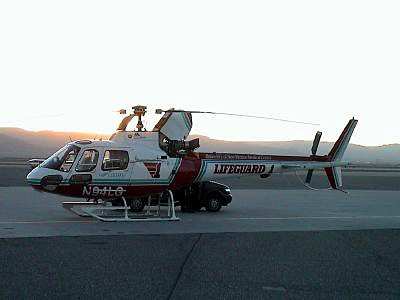
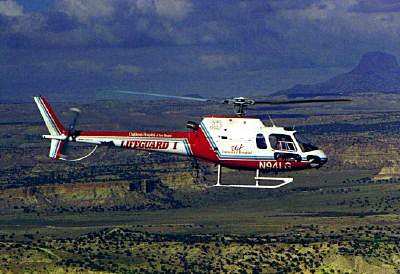
No one else was aboard the Eurocopter AS350-B3 A-Star helicopter, and the condition of the helicopter was not known at press time. The file photo seen here shows one of the UNM fleet. Three A-Stars are in use, one in Taos, one in Grants, and one in Albequerque.

The FAA is investigating the accident. So far, heavy snows have prevented investigators from reaching the crash site.

UNM's lifeguard fleet is managed by PHI. The hospital's website notes that its flight crew members have a total of 557 years of experience, and that's 16 years per individual on average.

Life flight operations are one of the riskiest ops in general aviation, despite the extreme professionalism of most operators, just because of the many inherent risk factors: low-visibility operations, unprepared landing zones, and life-in-the-balance pressure. Many of the crews have internalized the old Coast Guard life saving code: "You have to go out, but you don't have to come back."

It was always the greatest dream of Igor Sikorsky that his invention would be used for saving lives, and he always thrilled to news of helicopters saving lives, and kept a scrapbook of such rescues all his life. Our congratulations to Neal, on living to save lives again.

FMI: www.hsc.unm.edu/lifeguard

Advertisement

More News

Classic Aero-TV: Extra; the Airplane, the Man, and His Grand DeLand Plan

From 2023 (YouTube Edition): Germany’s Best by Way of Florida Established in 1980 by German aerobatic pilot Walter Extra as a means by which to design and develop his own air>[...]

ANN FAQ: Follow Us On Instagram!

Get The Latest in Aviation News NOW on Instagram Are you on Instagram yet? It's been around for a few years, quietly picking up traction mostly thanks to everybody's new obsession >[...]

Aero-News: Quote of the Day (11.27.25)

“Achieving PMA for the S-1200 Series magnetos is another step in expanding our commitment to providing the aviation community with the most trusted and durable ‘firewal>[...]

ANN's Daily Aero-Term (11.27.25): Ultralight Vehicle

Ultralight Vehicle A single-occupant aeronautical vehicle operated for sport or recreational purposes which does not require FAA registration, an airworthiness certificate, or pilo>[...]

ANN's Daily Aero-Linx (11.27.25)

Aero Linx: The de Havilland Moth Club Ltd The de Havilland Moth Club evolved from a belief that an association of owners and operators of Moth aeroplanes should be formed to create>[...]

blog comments powered by Disqus



Advertisement

Advertisement

Podcasts

Advertisement

© 2007 - 2025 Web Development & Design by Pauli Systems, LC

