
Wright Electric Launches Zero-Emissions RJ Program | Aero-News Network
Aero-News Network
RSS icon RSS feed
podcast icon MP3 podcast
Subscribe Aero-News e-mail Newsletter Subscribe

Airborne Unlimited -- Most Recent Daily Episodes

Episode Date

Airborne-Monday

Airborne-Tuesday

Airborne-Wednesday Airborne-Thursday

Airborne-Friday

Airborne On YouTube

Airborne-Unlimited-12.08.25

AirborneNextGen-
12.02.25

Airborne-Unlimited-12.03.25

Airborne-FltTraining-12.04.25

AirborneUnlimited-12.05.25

AFE 2025 LIVE MOSAIC Town Hall (Archived): www.airborne-live.net

Mon, Nov 08, 2021

Wright Electric Launches Zero-Emissions RJ Program

World’s First All-Electric, 100-Passenger Regional Jet

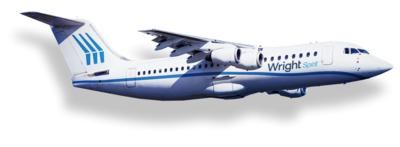
Wright Electric, Inc. announced the newest addition to their zero-emission portfolio, in conjunction with the UN Climate Change Conference in Glasgow, Scotland. The Wright Spirit is a 100-passenger, one-hour flight regional jet with megawatt-class propulsion. Using the short-haul BAe 146 platform as a starting point, the 4-engine jet sports a famously quiet operational signature and robust, simple construction.

Wright chose it for its relative quietness (though mostly a product of its stock turbine engines) , as it dovetails nicely into their plans for a 100% reduction in all emissions starting in 2026. CEO Jeff Engler says there’s hardly a better company in the market to build this kind of aircraft. ““Because we built the world's largest aerospace propulsive powertrain, we can build the world's largest zero-emissions retrofit directly serving the world's busiest routes,” he said at the announcement. Wright’s progress has been moving along at a brisk pace, having begun development of their megawatt propulsion system in early 2020. In the span of 2 years, the company has built their own high-efficiency, high-power density inverter with a 2,700 horsepower motor. The BAe 146 will see its stock fuel-based system replaced with Wright’s propulsion system. 

Wright’s design philosophy targets a core of one-hour flight city pairs, ferrying passengers between relatively close but populous locales. San Francisco to Los Angeles, London to Paris, and Seoul to Jeju are all fertile ground for the Spirit to steal significant market share from noisier, thirstier, and dirtier aircraft. Development is currently proceeding on track, with flight testing to come in 2023 with a single electric propulsor in the place of one engine, moving to two electric replacements the following year, eventually resulting in the full bank of four electric propulsors in 2026, with entry into service (theoretically) soon after. 

FMI: www.weflywright.com

Advertisement

More News

NTSB Final Report: Patriot Aircraft LLC CX1900A

After Draining Both Wing Fuel Tanks, A Significant Amount Of Water Was Observed In The Right Wing Fuel Tank Analysis: The pilot, who was also the owner of the experimental amateur->[...]

Aero-News: Quote of the Day (12.06.25)

“Airbus apologises for any challenges and delays caused to passengers and airlines by this event. The Company thanks its customers, the authorities, its employees and all rel>[...]

ANN's Daily Aero-Term (12.06.25): High Speed Taxiway

High Speed Taxiway A long radius taxiway designed and provided with lighting or marking to define the path of aircraft, traveling at high speed (up to 60 knots), from the runway ce>[...]

ANN's Daily Aero-Linx (12.06.25)

Aero Linx: Taylorcraft Foundation, Inc. The Taylorcraft Foundation is exclusively organized for charitable, educational & scientific activities and will preserve the history an>[...]

Airborne-NextGen 12.02.25: Honda eVTOL, Arctus High-Alt UAS, Samson Patent

Also: USAF Reaper Accident, Baikonur Damage, Horizon eVTOL IFR/FIKI, New Glenn Update Honda has outlined its clearest timeline yet for its entry into the world of electric vertical>[...]

blog comments powered by Disqus



Advertisement

Advertisement

Podcasts

Advertisement

© 2007 - 2025 Web Development & Design by Pauli Systems, LC

