
NASA Unveils Orion During Ceremony | Aero-News Network
Aero-News Network
RSS icon RSS feed
podcast icon MP3 podcast
Subscribe Aero-News e-mail Newsletter Subscribe

Airborne Unlimited -- Most Recent Daily Episodes

Episode Date

Airborne-Monday

Airborne-Tuesday

Airborne-Wednesday Airborne-Thursday

Airborne-Friday

Airborne On YouTube

Airborne-Unlimited-12.01.25

AirborneNextGen-
12.02.25

Airborne-Unlimited-11.19.25

Airborne-AffordableFlyers-11.20.25

AirborneUnlimited-11.21.25

LIVE MOSAIC Town Hall (Archived): www.airborne-live.net

Tue, Jul 03, 2012

NASA Unveils Orion During Ceremony

Agency Takes The Wraps Off First Capsule Destined For Space

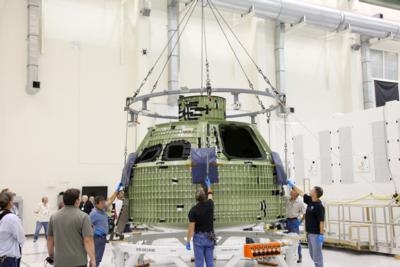
The first space-bound Orion capsule has arrived at NASA's Kennedy Space Center in Florida where technicians will turn it into a fully functioning spacecraft ahead of a test flight slated for 2014. The uncrewed flight, called Exploration Flight Test-1 or EFT-1, will be loaded with a wide variety of instruments to evaluate how the spacecraft behaves during launch, in space, and through reentry.

Lori Garver, NASA's deputy administrator, joined a group of officials on Monday to welcome the Orion spacecraft, marking its arrival at Kennedy -- a major milestone in the construction of the vehicle. The space-bound Orion was welded at NASA's Michoud Assembly Facility in New Orleans, in the same factory that built the external tanks for space shuttle missions.

Assembly at Kennedy will take place in the high bay of the Operations and Checkout Building, or O&C. The O&C was refurbished extensively in 2006 and has been outfitted with large fixtures and tools to turn the aluminum shell of Orion into a functioning spacecraft complete with avionics, instrumentation and heat shield.

In 2014, a Delta IV-Heavy rocket from United Launch Alliance will lift the spacecraft into orbit. Its second stage will remain attached to the capsule and will be fired to raise the Orion's orbit to 3,600 miles, about 15 times higher than the International Space Station. The mission will last only a few hours, long enough to make two orbits before being sent plunging back into the atmosphere to test it as deep-space reentry speeds.

Designed with astronauts in mind, Orion will take crews beyond Earth orbit for the first time since 1972, when Apollo 17 completed the last moon landing. The Space Launch System, or SLS -- a gigantic rocket akin to the Saturn V that launched the Apollo spacecraft -- is being developed to launch future Orion missions to deep space. The first launch of the SLS, with Orion atop, is scheduled for 2017.

NASA plans for later Orion spacecraft to take astronauts on missions to destinations far beyond Earth, like an asteroid and Mars.

FMI: www.nasa.gov

Advertisement

More News

NTSB Prelim: Cirrus Design Corp SR20

The Airplane Made An Uncommanded Right Yaw And Roll, And He Was Unable To Maintain Control Of The Airplane On November 11, 2025, about 1750 central standard time, a Cirrus SR20, N8>[...]

ANN's Daily Aero-Linx (11.30.25)

Aero Linx: Florida Antique Biplane Association "Biplanes.....outrageous fun since 1903." That quote really defines what the Florida Antique Biplane Association (FABA) is all about.>[...]

ANN's Daily Aero-Term (11.30.25): Wind Shear Escape

Wind Shear Escape An unplanned abortive maneuver initiated by the pilot in command (PIC) as a result of onboard cockpit systems. Wind shear escapes are characterized by maximum thr>[...]

Aero-News: Quote of the Day (11.30.25)

“Working closely with the Polish Armed Forces, we’re focused on disciplined execution to help enhance Poland’s defense capabilities and keep up with the strong de>[...]

Airborne 11.26.25: Bonanza-Baron Fini, Archer v LA NIMBYs, Gogo Loses$$$

Also: Bell 505 on SAF, NYPA Gets Flak For BizAv 'Abuse', FAA Venezuela Caution, Horizon Update Textron Aviation has confirmed it will be ending production of the Beechcraft Bonanza>[...]

blog comments powered by Disqus



Advertisement

Advertisement

Podcasts

Advertisement

© 2007 - 2025 Web Development & Design by Pauli Systems, LC

