Fri, Apr 18, 2003
Northrop Grumman Corporation's Integrated Systems sector
continued its successful flight testing of the U.S. Navy's RQ-8A
Fire Scout vertical takeoff and landing tactical unmanned aerial
vehicle in March with the first flight fully operated from the U.S.
Marine Corps' (USMC) S-788, a HMMWV-mounted ground control station
(GCS).
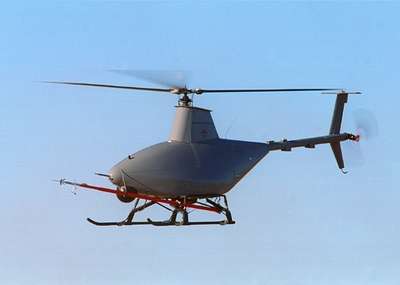
Conducted at the Webster Field annex of Naval Air Station
Patuxent River (MD), the flight fulfilled a key program test
objective of demonstrating Fire Scout operation by both U.S. Navy
and USMC ground control stations. (Fire Scout flew its first flight
operated by the Navy's S-280 GCS February 10.)
The S-788-operated flight was one of two Fire Scout flights
conducted on the same day. The first flight, a 20-minute
demonstration flight for senior U.S. Army aviation leadership, was
operated from the Navy's S-280 GCS. Less than an hour later, the
Fire Scout was launched for a functional check flight under the
control of the S-788 GCS. The back-to-back test flights marked the
first time that Fire Scout flights were operated from Marine Corps
and Navy ground control stations on the same day.
"The short turnaround time between flights and the ease of
switching from Navy ground control to Marine Corps ground control
provided a compelling demonstration of the robustness and
flexibility of the Fire Scout system design," said T. Scott
Winship, Northrop Grumman's Fire Scout program manager. "These test
results reinforce our confidence in Fire Scout's ability to provide
high-value support for critical Navy and Marine Corps
missions."
 During
the Marine Corps-controlled flight, the S-788 GCS used its tactical
control datalink to uplink payload command and control to Fire
Scout and to downlink imagery. The ARC-210 datalink was used for
air vehicle command and control. Use of this command and control
software continues to reduce risk as the system is prepared to
qualify and test the tactical control system software during flight
test later this spring.
During
the Marine Corps-controlled flight, the S-788 GCS used its tactical
control datalink to uplink payload command and control to Fire
Scout and to downlink imagery. The ARC-210 datalink was used for
air vehicle command and control. Use of this command and control
software continues to reduce risk as the system is prepared to
qualify and test the tactical control system software during flight
test later this spring.
As in all previous Fire Scout flight tests, the USMC and Navy
test flights were fully autonomous missions that included vertical
takeoff, accurate navigation, full payload operation and return to
a predetermined hover point in preparation for landing, all without
operator intervention.
More News
Light Gun A handheld directional light signaling device which emits a brilliant narrow beam of white, green, or red light as selected by the tower controller. The color and type of>[...]
“We have performed extensive ground testing by comparing warm up times, full power tethered pulls, and overall temperatures in 100 degree environments against other aircraft >[...]
While Taxiing To Parking The Right Landing Gear Leg Collapsed, Resulting In Substantial Damage Analysis: The pilot made a normal approach with full flaps and landed on the runway. >[...]
From 2014 (YouTube Edition): Exotic Rebuild Reveals Aerial Work Of Art During EAA AirVenture 2014, ANN's Michael Maya Charles took the time to get a history lesson about a great ai>[...]
Also: Project Talon, McFarlane Acquisition, Sky-Tec Service, JPL Earth Helo Tests Bombardier has earned a round of applause from the business aviation community, celebrating the fo>[...]



 ANN's Daily Aero-Term (12.13.25): Light Gun


 See All