
Columbia's Version Of 'Arlington National Cemetery' | Aero-News Network
Aero-News Network
RSS icon RSS feed
podcast icon MP3 podcast
Subscribe Aero-News e-mail Newsletter Subscribe

Airborne Unlimited -- Most Recent Daily Episodes

Episode Date

Airborne-Monday

Airborne-Tuesday

Airborne-Wednesday Airborne-Thursday

Airborne-Friday

Airborne On YouTube

Airborne-Unlimited-11.24.25

AirborneNextGen-
11.18.25

Airborne-Unlimited-11.19.25

Airborne-AffordableFlyers-11.20.25

AirborneUnlimited-11.21.25

LIVE MOSAIC Town Hall (Archived): www.airborne-live.net

Sun, Feb 01, 2004

Columbia's Version Of 'Arlington National Cemetery'

Final Resting Place For Shuttle Debris

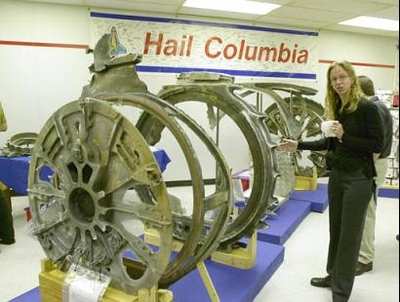
In stark contrast to the remains of the shuttle Challenger, debris from NASA's first space plane, Columbia, is not buried deep inside an abandoned missile silo. Instead, it is on display at Cape Canaveral, where reporters and photographers Friday were allowed to survey the wreckage. It's also where scientists believe they can still glean useful information on the fiery death of Columbia, one year ago Sunday.

"Columbia was a great ship," said Michael Leinbach, launch director for the shuttle program. "We like to call this the Arlington Cemetery for Columbia."

Columbia disintegrated February 1, 2003, just minutes away from landing at Florida's Kennedy Space Center. The debris rained down on eastern Texas and western Louisiana. Parts of the shuttle are still being discovered a year later.

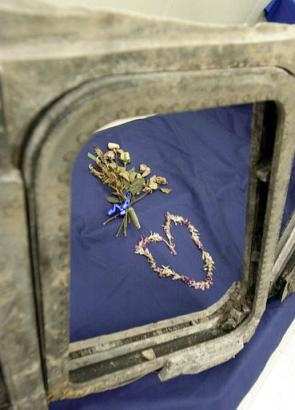
The debris recovered so far -- more than 84,000 pounds of it -- is neatly stacked, crated and labeled with bar codes. The frames that encased the shuttle's windshield panels are still remarkably intact, although little of the glass they once contained is left. A hatch door seems almost undamaged, in spite of the fiery break-up and its fall to Earth from more than 60,000 feet. The crew compartment, however, is in a separate room of the repository. Access to the compartment is restricted by the Astronaut Office.

"It'll happen eventually," said Scott Thurston, the Columbia vehicle manager. "Somebody will have a good safety idea and they'll need access to the crew compartment. And, of course, the astronauts have a personal interest in that."

In fact, NASA is keeping the debris close at hand partially for that very reason. Several parts of the destroyed shuttle are being studied by the space agency to further determine the events leading to Columbia's destruction. So far, NASA says about 20 research institutes, mostly affiliated with universities, have expressed interest in studying the debris in hopes of finding safer ways to get humans to and from space.

Back in that room housing the crew compartment, there are also thousands and thousands of sympathy cards and remembrance sent to the space agency and the astronauts' families after the disaster.

"It helps us when we come into this room," "It helps us when we come into this room. It was stuff we just couldn't destroy," said Leinbach. "It was stuff we just couldn't destroy."

FMI: www.nasa.gov

Advertisement

More News

Classic Aero-TV: Extra; the Airplane, the Man, and His Grand DeLand Plan

From 2023 (YouTube Edition): Germany’s Best by Way of Florida Established in 1980 by German aerobatic pilot Walter Extra as a means by which to design and develop his own air>[...]

ANN FAQ: Follow Us On Instagram!

Get The Latest in Aviation News NOW on Instagram Are you on Instagram yet? It's been around for a few years, quietly picking up traction mostly thanks to everybody's new obsession >[...]

Aero-News: Quote of the Day (11.27.25)

“Achieving PMA for the S-1200 Series magnetos is another step in expanding our commitment to providing the aviation community with the most trusted and durable ‘firewal>[...]

ANN's Daily Aero-Term (11.27.25): Ultralight Vehicle

Ultralight Vehicle A single-occupant aeronautical vehicle operated for sport or recreational purposes which does not require FAA registration, an airworthiness certificate, or pilo>[...]

ANN's Daily Aero-Linx (11.27.25)

Aero Linx: The de Havilland Moth Club Ltd The de Havilland Moth Club evolved from a belief that an association of owners and operators of Moth aeroplanes should be formed to create>[...]

blog comments powered by Disqus



Advertisement

Advertisement

Podcasts

Advertisement

© 2007 - 2025 Web Development & Design by Pauli Systems, LC

