Inmarsat-2 F1 Satellite Retired After More Than 22.5 Years Of Successful Operation In Geostationary Orbit
The first Eurostar satellite, Inmarsat-2 F1, designed and built by Astrium, Europe’s leading space technology company, was retired from operational service this week and safely decommissioned after it had completed a long and flawless mission in geostationary orbit. It operated for 22.5 years - far outliving its projected life-span of 10 years.
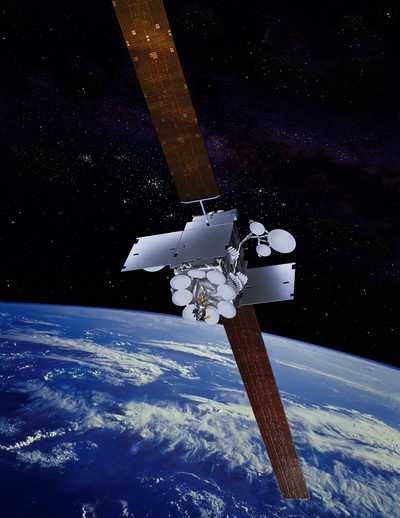
Launched in October 1990, Inmarsat 2 F1 was the first ever Astrium’s Eurostar satellite, and the first commercial satellite in the world to rely entirely on a digital system which could be reprogrammed in orbit. Operators benefited from a new concept in the ease of satellite operations, with solar sailing and autonomy providing a much reduced risk of operational errors, resulting in an excellent availability record for this class of satellite.
Inmarsat-2 F1 was the first of a series of four Eurostar E1000 satellites built for Inmarsat. All four spacecraft have far exceeded their design requirements, largely surpassing their 10 years design lifetime in orbit: Inmarsat 2 F3 and F4 were safely decommissioned after more than 15 and 20 years of operation respectively, and F2 is still in operation more than 22 years after its launch in March 1991.
Eric Béranger, Astrium Satellites CEO, commented: “The 22.5 years longevity of Inmarsat-2 F1, initially designed for a 10 year lifetime, is a great achievement that demonstrates the expertise of Inmarsat operations and Astrium engineering/support teams. The Eurostar platform has evolved over the years, the performance and capacity have been considerably enhanced, more than 15 year lifetime now, but more than ever our star product relies on the strong design ability, quality processes and organization that are key to ensure the reliability of our products.”
Eurostar is Astrium’s flagship workhorse product for geostationary communications satellites, on which many successful satellites have been built, including the highly sophisticated Inmarsat-4 constellation which delivers broadband services at a global scale, high capacity broadcast and broadband satellites for leading operators worldwide, as well as the Skynet 5 secure military communications satellites.
A total of 54 Eurostar satellites have been successfully launched to date and have proven highly reliable in orbit. None has ever been lost in orbit. 13 have been retired from operational service after having successfully completed their mission, exceeding their design lifetime by an average of 79%. 41 are still in service, including 10 operating beyond their design lifetime by an average of 27%. Altogether, the Astrium Eurostar satellites have accumulated more than 470 years of successful operation in orbit, including 125 years for the most advanced Eurostar E3000 model introduced in orbit in 2004 and now a best seller in its class. Astrium delivered and launched an average of more than four Eurostar E3000 satellites per year during the last five years and is expected to do so in the next years: 12 Eurostar E3000 satellites are currently at various stages of production in Astrium facilities.
(Inmarsat image from file)



 Classic Aero-TV: Extra; the Airplane, the Man, and His Grand DeLand Plan


 See All