Thruster Tests Complete For Boeing's Crew Capsule | Aero-News Network
Aero-News Network
RSS icon RSS feed
podcast icon MP3 podcast
Subscribe Aero-News e-mail Newsletter Subscribe

** AIRBORNE 06.18.13 Aero-TV-- CLICK HERE! ** HD iPad-Friendly Version -- AIRBORNE 06.18.13 **

** AIRBORNE 06.14.13 Aero-TV-- CLICK HERE! ** HD iPad-Friendly Version -- AIRBORNE 06.14.13**

** AIRBORNE 04.01.13 SPECIAL EDITION of Aero-TV-- CLICK HERE! ** HD iPad-Friendly Version -- AIRBORNE 04.01.13 SPECIAL EDITION **

Thu, Jun 28, 2012

Thruster Tests Complete For Boeing's Crew Capsule

CST-100 Attitude Control System Will Be Comprised Of Twenty-Four Of The Thrusters

A series of tests on a thruster destined for Boeing's Commercial Space Transportation spacecraft, designated CST-100, was completed recently by Pratt & Whitney Rocketdyne. Boeing is one of several companies working to develop crew transportation capabilities under the Commercial Crew Development Round 2 agreement with NASA's Commercial Crew Program.

Twenty-four thrusters will be part of the spacecraft's orbital maneuvering and attitude control system (OMAC), giving the CST-100 the ability to maneuver in space and during re-entry. The thrusters also will allow the spacecraft to separate from its launch vehicle if an abort becomes necessary during launch or ascent.

"Boeing and Pratt and Whitney Rocketdyne know what it takes to develop safe systems and subsystems," said NASA Commercial Crew Program Manager Ed Mango. "They're building on the successes of their past, while pushing the envelope with next-generation ideas to create a spacecraft for low Earth orbit transportation."

During tests conducted at the White Sands Space Harbor in Las Cruces, NM, an OMAC thruster was fired in a vacuum chamber that simulated a space-like environment of 100,000 feet. The tests verified the durability of the thrusters in extreme heat, evaluated the opening and closing of its valves and confirmed continuous combustion and performance. "We're excited about the performance of the engine during the testing and confident the OMAC thrusters will affordably meet operational needs for safe, reliable human spaceflight," said Terry Lorier, Pratt and Whitney Rocketdyne's Commercial Crew Development program manager.

All of NASA's industry partners, including Boeing, continue to meet their established milestones in developing commercial crew transportation capabilities.

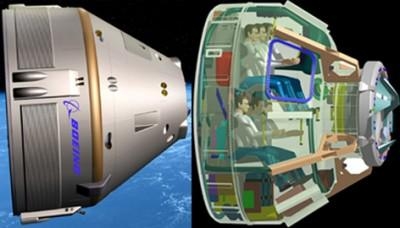
NASA also is developing the Orion spacecraft and Space Launch System (SLS), a crew capsule and heavy-lift rocket that will provide an entirely new capability for human exploration beyond low Earth orbit. Designed to be flexible for launching spacecraft for crew and cargo missions, SLS and Orion will expand human presence beyond low Earth orbit and enable new missions of exploration across the solar system. (Image provided by Boeing)

FMI: www.nasa.gov/commercialcrew

Advertisement

More News

Progress! Great Lakes by Waco Classic Makes First Flight

First Flight 'Exceeds Expectations' It's been a long time since we could announce the first flight of a new production aircraft... but we'll take whatever progress we can find... a>[...]

Airborne 06.14.13: FAA Extorts $447K From EAA, Eurocopter's X3, TIGHAR Denials

Also: Hadfield Retires, Dornier Do 17, Chinook Contract, Boeing Forecast, Wright Memorial We can't say that this was unexpected but EAA has confirmed that it has entered, reluctant>[...]

Avidyne Reduced Cost Warranty Program May Be No Bargain -- Legally Speaking

Avidyne User Community Increasingly Vocal About Legal Concerns Over Warranty Indemnifications It was presented as a bargain to certain Avidyne avionics product owners who wanted to>[...]

Aero-News: Quote Of The Day (06.17.13)

"The aviation community can expect much more of the same... and while many events will be able to 'punt' and do what they need to do without the 'assistance' of the FAA; those even>[...]

FAA Strikes Again... Father's Day Fly-In Can't Afford FAA Temp Tower Fees

Another Sign Of The Times Casts Dark Shadow Over GA If there was ever any question as to who worked for who in terms of the FAA v The Aviation World, that time seems to have come a>[...]

blog comments powered by Disqus


Advertisement

Advertisement

Podcasts

Advertisement

© 2007 - 2013 Web Development & Design by Pauli Systems, LC