

NTSB Determines UPS Flight 1354 Probable Cause | Aero-News Network
Aero-News Network
RSS icon RSS feed
podcast icon MP3 podcast
Subscribe Aero-News e-mail Newsletter Subscribe

Airborne Unlimited -- Most Recent Daily Episodes

Episode Date

Airborne-Monday

Airborne-Tuesday

Airborne-Wednesday Airborne-Thursday

Airborne-Friday

Airborne On YouTube

Airborne-Unlimited-12.08.25

AirborneNextGen-
12.09.25

Airborne-Unlimited-12.10.25

Airborne-AffordableFlyers-12.11.25

AirborneUnlimited-12.12.25

AFE 2025 LIVE MOSAIC Town Hall (Archived): www.airborne-live.net

Thu, Sep 11, 2014

NTSB Determines UPS Flight 1354 Probable Cause

Finds Mismanagement Of Approach And Failure To Go-Around Led To The Accident

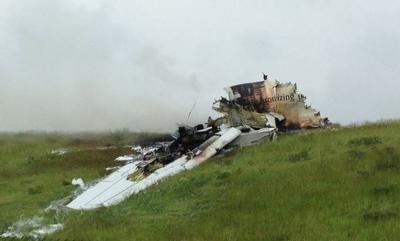
The NTSB has determined that UPS flight 1354 went down because the crew continued an unstabilized approach into Birmingham-Shuttlesworth International Airport in Birmingham, AL. In addition, the crew failed to monitor the altitude and inadvertently descended below the minimum descent altitude when the runway was not yet in sight.

The board also found that the flight crew’s failure to properly configure the on-board flight management computer, the first officer’s failure to make required call-outs, the captain’s decision to change the approach strategy without communicating his change to the first officer, and flight crew fatigue all contributed to the accident.

The airplane, an Airbus A300-600, crashed in a field short of runway 18 in Birmingham on August 14, 2013, at 4:47 a.m. The captain and first officer, the only people aboard, both lost their lives, and the airplane was destroyed by the impact and a post-crash fire. The flight originated from UPS’s hub in Louisville, KY.

“An unstabilized approach is a less safe approach,” said NTSB Acting Chairman Christopher A. Hart. “When an approach is unstable, there is no shame in playing it safe by going around and trying again.”

The NTSB determined that because the first officer did not properly program the flight management computer, the autopilot was not able to capture and fly the desired flight path onto runway 18. When the flight path was not captured, the captain, without informing the first officer, changed the autopilot mode and descended at a rate that violated UPS’s stabilized approach criteria once the airplane descended below 1,000 feet above the airport elevation.

As a result of this accident investigation, the NTSB made recommendations to the FAA, UPS, the Independent Pilots Association and Airbus. The recommendations address safety issues identified in the investigation, including ensuring that operations and training materials include clear language requiring abandoning an unstable approach; the need for recurrent dispatcher training that includes both dispatchers and flight crews; the need for all relevant weather information to be provided to pilots in dispatch and enroute reports; opportunities for improvement in fatigue awareness and management among pilots and operators; the need for increased awareness among pilots and operators of the limitations of terrain awareness and warning systems -- and for procedures to assure safety given these limitations.

(NTSB Images)

FMI: www.ntsb.gov/investigations/2013/birmingham_al/birmingham_al.html

Advertisement

More News

Aero-News: Quote of the Day (12.09.25)

“We respectfully call on the City of Mesa to: 1. Withdraw the landing fee proposal immediately 2. Engage with the aviation community before making decisions that impact safet>[...]

ANN's Daily Aero-Term (12.09.25): High Speed Taxiway

High Speed Taxiway A long radius taxiway designed and provided with lighting or marking to define the path of aircraft, traveling at high speed (up to 60 knots), from the runway ce>[...]

ANN's Daily Aero-Linx (12.09.25)

Aero Linx: International Federation of Airworthiness (IFA) IFA uniquely combines together all those with responsibility for policies, principles and practices concerned with the co>[...]

NTSB Final Report: Diamond Aircraft Ind Inc DA20C1 (A1); Robinson Helicopter R44

Controller’s Expectation That VW02 Would Have Departed Sooner Led To An Inadequate Scan And Loss Of Situational Awareness Analysis: A Robinson R-44 helicopter N744AF, VW02 (V>[...]

ANN FAQ: Q&A 101

A Few Questions AND Answers To Help You Get MORE Out of ANN! 1) I forgot my password. How do I find it? 1) Easy... click here and give us your e-mail address--we'll send it to you >[...]

blog comments powered by Disqus



Advertisement

Advertisement

Podcasts

Advertisement

© 2007 - 2025 Web Development & Design by Pauli Systems, LC

