Lander Ceases Communications With Earth
NASA's Phoenix Mars Lander has ceased communications after
operating for more than five months. As anticipated, seasonal
decline in sunshine at the robot's arctic landing site is not
providing enough sunlight for the solar arrays to collect the power
necessary to charge batteries that operate the lander's
instruments.
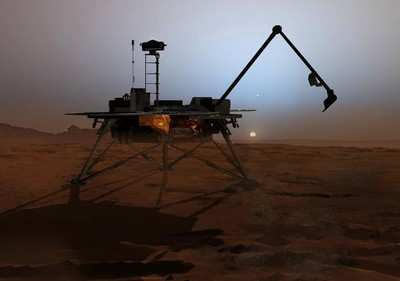
Mission engineers last received a signal from the lander on
November 2. Phoenix, in addition to shorter daylight, has
encountered a dustier sky, more clouds and colder temperatures as
the northern Mars summer approaches autumn. The mission exceeded
its planned operational life of three months to conduct and return
science data.
The project team will be listening carefully during the next few
weeks to hear if Phoenix revives and phones home. However,
engineers now believe that is unlikely because of the worsening
weather conditions on Mars. While the spacecraft's work has ended,
the analysis of data from the instruments is in its earliest
stages.
"Phoenix has given us some surprises, and I'm confident we will
be pulling more gems from this trove of data for years to come,"
said Phoenix Principal Investigator Peter Smith of the University
of Arizona in Tucson.
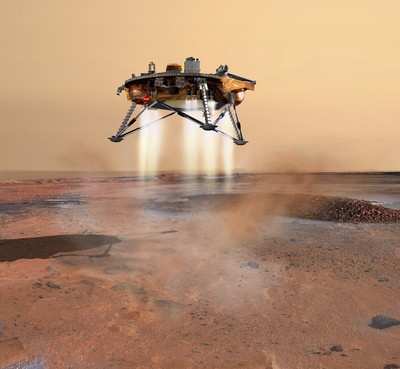
Launched August 4, 2007,
Phoenix landed May 25, 2008, farther north
than any previous spacecraft to land on the Martian surface. The
lander dug, scooped, baked, sniffed and tasted the Red Planet's
soil.
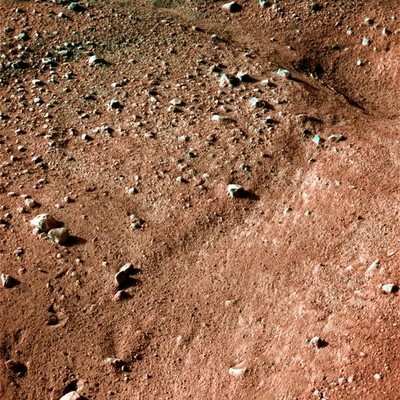
Among early results, it verified the presence of water-ice in
the Martian subsurface, which NASA's Mars Odyssey orbiter first
detected remotely in 2002. Phoenix's cameras also returned more
than 25,000 pictures from sweeping vistas to near the atomic level
using the first atomic force microscope ever used outside
Earth.
"Phoenix not only met the tremendous challenge of landing
safely, it accomplished scientific investigations on 149 of its 152
Martian days as a result of dedicated work by a talented team,"
said Phoenix Project Manager Barry Goldstein at NASA's Jet
Propulsion Laboratory in Pasadena, CA.
Phoenix's preliminary science accomplishments advance the goal
of studying whether the Martian arctic environment has ever been
favorable for microbes. Additional findings include documenting a
mildly alkaline soil environment unlike any found by earlier Mars
missions; finding small concentrations of salts that could be
nutrients for life; discovering perchlorate salt, which has
implications for ice and soil properties; and finding calcium
carbonate, a marker of effects of liquid water.
Phoenix findings also support the goal of learning the history
of water on Mars. These findings include excavating soil above the
ice table, revealing at least two distinct types of ice deposits;
observing snow descending from clouds; providing a mission-long
weather record, with data on temperature, pressure, humidity and
wind; observations of haze, clouds, frost and whirlwinds; and
coordinating with NASA's Mars Reconnaissance Orbiter to perform
simultaneous ground and orbital observations of Martian
weather.
"Phoenix provided an important step to spur the hope that we can
show Mars was once habitable and possibly supported life," said
Doug McCuistion, director of the Mars Exploration Program at NASA
Headquarters in Washington. "Phoenix was supported by orbiting NASA
spacecraft providing communications relay while producing their own
fascinating science. With the upcoming launch of the Mars Science
Laboratory, the Mars Program never sleeps."
The University of Arizona led the Phoenix mission with project
management at JPL and development partnership at Lockheed Martin
Corporation in Denver. International contributions came from the
Canadian Space Agency; the University of Neuchatel, Switzerland;
the universities of Copenhagen and Aarhus in Denmark; the Max
Planck Institute in Germany; the Finnish Meteorological Institute;
and Imperial College of London.



 Aero-News: Quote of the Day (12.09.25)


 See All