

Aero-TV Gets Rev'ed Up Over The RotaMax Rotary Powerplant | Aero-News Network
Aero-News Network
RSS icon RSS feed
podcast icon MP3 podcast
Subscribe Aero-News e-mail Newsletter Subscribe

Airborne Unlimited -- Most Recent Daily Episodes

Episode Date

Airborne-Monday

Airborne-Tuesday

Airborne-Wednesday Airborne-Thursday

Airborne-Friday

Airborne On YouTube

Airborne-Unlimited-12.08.25

AirborneNextGen-
12.09.25

Airborne-Unlimited-12.10.25

Airborne-AffordableFlyers-12.11.25

AirborneUnlimited-12.12.25

AFE 2025 LIVE MOSAIC Town Hall (Archived): www.airborne-live.net

Tue, Sep 16, 2008

Aero-TV Gets Rev'ed Up Over The RotaMax Rotary Powerplant

Rotary Motivations: The RotaMax Powerplant Program

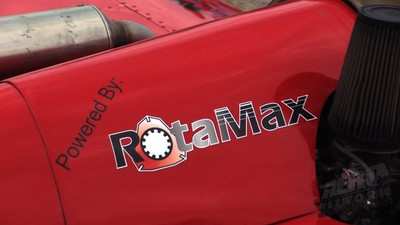
In the midst of all the amazing things that comprise the annal Oshkosh Fly-In, Aero-TV took some time out at the 2008 rendition to talk with Eric Barger, President of RotaMax Rotary Engines. This company is introducing a line of aviation rotaries based on a long-established, non-automotive design. The company recently signed a tentative OEM agreement to furnish a twin-rotor powerplant for an upcoming light-sport aircraft.

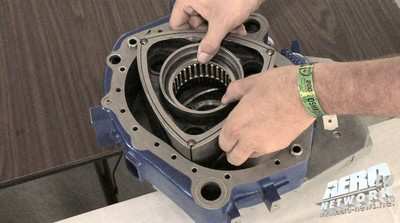
The RotaMax engine is a Wankel-type rotary engine, named after the German inventor Felix Wankel. Instead of conventional pistons reciprocating inside cylinders with a complex valvetrain, the Wankel has a rotor shaped roughly like a triangle that runs inside a housing with an epitrochoidal cavity shaped roughly like a figure 8. The rotor is geared in relation to an eccentric shaft, which is the equivalent to the crankshaft inside a piston engine. The rotor covers and uncovers ports as it rotates inside the housing, enabling four-stroke Otto-cycle operation without valves. The rotor uses seals as the equivalent of piston rings, including apex seals at the points of the rotor and side seals on the sides.

RotaMax opines that Wankel engines are inherently smoother and easier to balance because of the rotary operation. For the same output as a piston engine, a Wankel will generally be smaller and lighter and will have far fewer parts, particularly moving parts.  In certain applications even in the 1970s, for the power produced in the application the rotary had—and has—favorable fuel economy. Because it has a four-stroke cycle, the rotary can use the same performance tuning operations, external accessories, and emissions control devices as a conventional engine.

RotaMax has particularly high hopes for their future aviation offerings. They note that 'Aviation Enthusiasts are always searching for more power! But, they want it with lower emissions, lower vibration, higher power-to-weight, smaller package. We are currently working with several manufacturers designing next generation aircraft for the RotaMax Rotary Engine.'

Though currently not certified, RotaMax explains that they are doing the work necessary to assure that their twin-spark, twin ignition engines will conform to the ASTM E-LSA, S-LSA, LSA protocols... and with enough time and experience, General Aviation Certification. They feel they have an interesting powerplant for a number of air vehicles... be they airships, blimps, gyrocopters, fixed wings, floatplanes or seaplanes, Ultralights, Light Sport Aircraft (S-SLA), Experimental, Homebuilt Kits, or Helicopters.

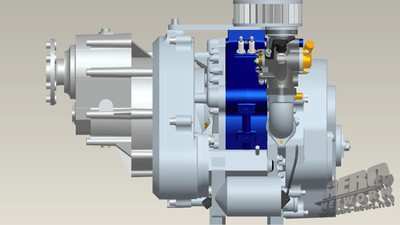
RotaMax is currently concentrating its efforts on two aviation powerplant platforms with two variations of each:

  • A Gear-Reduced 650cc Single Rotor Down Draft Engine
  • A Gear-Reduced 650cc Single Rotor Side Draft Engine
  • A Gear-Reduced 1300cc Twin Rotor Down Draft Engine 
  • A Gear-Reduced 1300cc Twin Rotor Side Draft Engine 

Rev Up Your Rotary Engine Knowledge With Aero-TV and RotaMax Rotary Engines!

FMI: www.rotamax.net, www.youtube.com/aerotvnetwork, www.twitter.com/aeronews

Advertisement

More News

ANN's Daily Aero-Term (12.13.25): Light Gun

Light Gun A handheld directional light signaling device which emits a brilliant narrow beam of white, green, or red light as selected by the tower controller. The color and type of>[...]

Aero-News: Quote of the Day (12.13.25)

“We have performed extensive ground testing by comparing warm up times, full power tethered pulls, and overall temperatures in 100 degree environments against other aircraft >[...]

NTSB Final Report: Gippsland GA-8

While Taxiing To Parking The Right Landing Gear Leg Collapsed, Resulting In Substantial Damage Analysis: The pilot made a normal approach with full flaps and landed on the runway. >[...]

Classic Aero-TV: Historically Unique -- Marlin Horst's Exquisite Fairchild 71

From 2014 (YouTube Edition): Exotic Rebuild Reveals Aerial Work Of Art During EAA AirVenture 2014, ANN's Michael Maya Charles took the time to get a history lesson about a great ai>[...]

Airborne 12.12.25: Global 8000, Korea Pilot Honors, AV-30 Update

Also: Project Talon, McFarlane Acquisition, Sky-Tec Service, JPL Earth Helo Tests Bombardier has earned a round of applause from the business aviation community, celebrating the fo>[...]

blog comments powered by Disqus



Advertisement

Advertisement

Podcasts

Advertisement

© 2007 - 2025 Web Development & Design by Pauli Systems, LC

