
Waverider Breaks Apart About A Half-Minute Into Test Flight | Aero-News Network
Aero-News Network
RSS icon RSS feed
podcast icon MP3 podcast
Subscribe Aero-News e-mail Newsletter Subscribe

Airborne Unlimited -- Most Recent Daily Episodes

Episode Date

Airborne-Monday

Airborne-Tuesday

Airborne-Wednesday Airborne-Thursday

Airborne-Friday

Airborne On YouTube

Airborne-Unlimited-12.08.25

AirborneNextGen-
12.09.25

Airborne-Unlimited-12.10.25

Airborne-AffordableFlyers-12.11.25

AirborneUnlimited-12.12.25

AFE 2025 LIVE MOSAIC Town Hall (Archived): www.airborne-live.net

Thu, Aug 16, 2012

Waverider Breaks Apart About A Half-Minute Into Test Flight

USAF Officials Point To A Faulty Control Fin On The Aircraft

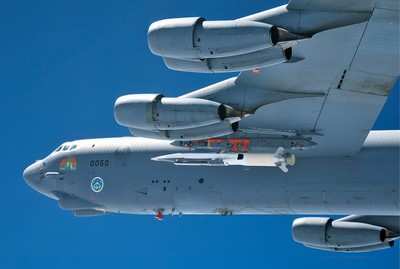
The X-51 Waverider hypersonic aircraft failed fairly spectacularly during a test flight Tuesday. The experimental unmanned aircraft reportedly broke apart over the Pacific ocean just 31 seconds after it launched from the wing of a B-52.

Reuters reports that, according to a statement released by the Air Force, a problem was detected with one of the aircraft's control fins about 16 seconds after its rocket motor ignited. When the rocket separated from the aircraft so that the scramjet could boost it to hypersonic speeds, the fin failed, and control was lost. The Waverider went down in the Pacific Ocean near Point Magu northwest of Los Angeles, according to Daryl Mayer, a spokesman for the 88th Air Base Wing at Wright-Patterson Air Force Base in Ohio.

The Air Force had hoped for a flight duration of five minutes, but only got 31 seconds, and only about half of that in controlled flight. It initially stayed on course using the fins on the rocket motor, but when those separated from the rest of the aircraft, control was lost, the Air Force said. The flight plan called for the aircraft to go down in the ocean, and it is considered unrecoverable.

This was the third test flight of the X-51. There is one more of the hypersonic experimental aircraft in the Air Force inventory. The aircraft in the previous test flew at speeds up to Mach 5 for three minutes before it went down in the ocean, which was the planned end to the flight profile. The Air Force is continuing to analyze the data from Tuesday's flight, and has not made a determination whether it will attempt to fly the fourth aircraft.

(Image courtesy of the U.S. Air Force)

FMI: www.af.mil

Advertisement

More News

ANN's Daily Aero-Term (12.13.25): Light Gun

Light Gun A handheld directional light signaling device which emits a brilliant narrow beam of white, green, or red light as selected by the tower controller. The color and type of>[...]

Aero-News: Quote of the Day (12.13.25)

“We have performed extensive ground testing by comparing warm up times, full power tethered pulls, and overall temperatures in 100 degree environments against other aircraft >[...]

NTSB Final Report: Gippsland GA-8

While Taxiing To Parking The Right Landing Gear Leg Collapsed, Resulting In Substantial Damage Analysis: The pilot made a normal approach with full flaps and landed on the runway. >[...]

Classic Aero-TV: Historically Unique -- Marlin Horst's Exquisite Fairchild 71

From 2014 (YouTube Edition): Exotic Rebuild Reveals Aerial Work Of Art During EAA AirVenture 2014, ANN's Michael Maya Charles took the time to get a history lesson about a great ai>[...]

Airborne 12.12.25: Global 8000, Korea Pilot Honors, AV-30 Update

Also: Project Talon, McFarlane Acquisition, Sky-Tec Service, JPL Earth Helo Tests Bombardier has earned a round of applause from the business aviation community, celebrating the fo>[...]

blog comments powered by Disqus



Advertisement

Advertisement

Podcasts

Advertisement

© 2007 - 2025 Web Development & Design by Pauli Systems, LC

