Seven Minutes To The Solar System's Largest Planet
 NASA invites the public to travel
to Jupiter from the comfort of one of 38 Science On a Sphere
theaters around the globe. Viewers will feel like they are in orbit
around the largest planet in our solar system as images based on
data from NASA missions are projected onto a 6-foot sphere in the
center of the theater.
NASA invites the public to travel
to Jupiter from the comfort of one of 38 Science On a Sphere
theaters around the globe. Viewers will feel like they are in orbit
around the largest planet in our solar system as images based on
data from NASA missions are projected onto a 6-foot sphere in the
center of the theater.
Called "LARGEST," the free, seven-minute presentation opens
September 15. "The movie has incredible visual appeal," said
astrophysicist Amy Simon-Miller of NASA's Goddard Space Flight
Center in Greenbelt, MD, who was a scientific consultant for the
production. "We think it will engage people and get them interested
in learning more about Jupiter and planetary exploration."
On September 24, the NASA Goddard Visitor Center will hold a
public lecture on this new movie. Dr. Amy Simon-Miller, Chief
Planetary Systems Laboratory at Goddard will provide details on
Jupiter's active environment and data collection. Michael Starobin,
Goddard's Senior Producer and the film's director, will discuss the
creative process and technical challenges for making a movie on a
sphere.
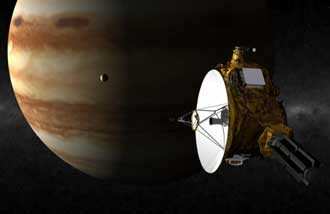
The film is based on data from NASA's robotic missions to the
outer solar system, including Voyager, Galileo, and Cassini, as
well as Hubble Space Telescope observations. Watching the movie
sends viewers on a journey stretching more than five times the
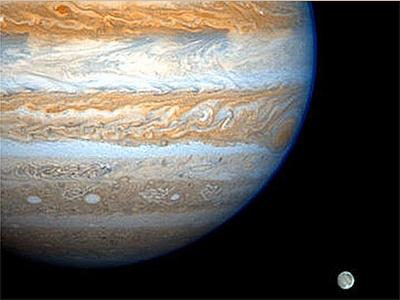
Earth-Sun distance. Jupiter is a "gas giant" -- more than 11 times
wider than Earth -- with a small core forever shrouded beneath a
cloak of toxic, roiling clouds and oceans of liquid metallic
hydrogen tens of thousands of miles deep.
Viewers will be treated to up-close-and-personal encounters of
the Great Red Spot, a storm larger than Earth that's been raging
for hundreds of years. They'll also experience dramatic fireballs
with up to six million megatons of explosive power from the impacts
of doomed comet Shoemaker-Levy 9, which left planet-sized "bruises"
of soot hanging for months in the Jovian atmosphere.
As virtual astronauts, visitors will also explore Jupiter's
swirling mini-solar system of more than 60 moons, including
tormented Io, which gushes fountains of molten sulfur over a
hundred miles high, and fractured Europa, which may harbor oceans
of liquid water, and possibly life, beneath its cracked, icy
crust.
Science On a Sphere is an exciting new projection technology
developed by the NOAA. "LARGEST" is the latest in a series of films
for the Sphere created by the team at NASA Goddard using new
techniques and technology of their own, designed specifically for
making spherical movies. In fact, LARGEST pushed the team to
develop several new presentation techniques, demonstrated
throughout the film.
"Jupiter is not only a perfect subject for the Sphere, but also
simply a great subject for a movie," said Senior Producer Michael
Starobin of Honeywell Technology Solutions, Inc., Columbia, MD. "It
presents itself as a regal, mighty character, and we tried hard to
invest its cinematic depiction with as much commanding grandeur as
possible. This is a movie that takes viewers somewhere way out of
the ordinary. It brings abstract ideas to vibrant life and makes
the fifth planet real in fresh, unexpected ways. This was a
thrilling project to develop." Starobin wrote, produced, and
directed the film.
"LARGEST" was funded by NASA's Educational and Public Outreach
in Earth and Space Science program at NASA Headquarters,
Washington. Over a dozen people from Goddard's Scientific
Visualization Studio and Conceptual Image Lab pioneered the
techniques used to make the film.



 ANN's Daily Aero-Term (12.13.25): Light Gun


 See All