Mon, May 23, 2016
Two Minute Full Duration Test Planned For June 28
NASA is planning to test the largest, most powerful booster in the world for the agency's new deep space rocket, the Space Launch System (SLS), on June 28 at Orbital ATK Aerospace System's test facility in Promontory, Utah.
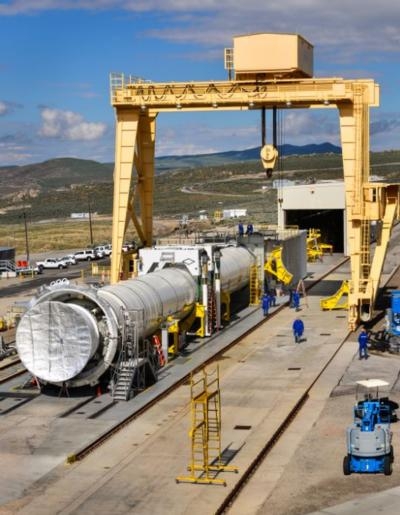
This will be the second two-minute, full-duration qualification test for the booster, and will provide NASA with critical data to support booster qualification for flight. It also will be the last time the booster is fired in a test environment before the first flight of SLS and Orion in 2018.
During the test, 82 qualification test objectives will be measured through more than 530 instrumentation channels on the booster at a target initial temperature of 40 degrees Fahrenheit – the colder end of its accepted propellant temperature range.
The first, full-scale booster qualification test was successfully completed in March 2015 and demonstrated acceptable performance of the booster design at 90 degrees Fahrenheit -- the highest end of the booster’s accepted propellant temperature range. Testing at the thermal extremes experienced by the booster on the launch pad is important to understanding the effects of temperature on the performance of the propellant.
Two five-segment solid rocket boosters and four RS-25 main engines will power the SLS. Solid rocket boosters operate in parallel with the main engines for the first two minutes of flight, providing more than 75 percent of the thrust needed for the rocket to overcome Earth’s gravitational pull.
The SLS Block I configuration will have a minimum 70-metric-ton (77-ton) lift capability and be powered by twin boosters and four RS-25 engines. The next planned upgrade of SLS, Block 1B, would use a more powerful exploration upper stage for more ambitious missions with a 105-metric-ton (115-ton) lift capacity. Block 2 will add a pair of more powerful boosters to provide a 130-metric-ton (143-ton) lift capacity. In each configuration, SLS will continue to use the same core stage and four RS-25 engines.
(Image provided with NASA news release)
More News
Its Offerings Are Lighter, Cleaner, and Now Pushing Past 1,000nm on SAF Jet Fuel DeltaHawk’s diesel-powered aircraft lineup has seen incredible upgrades over the last few yea>[...]
The Airplane Experienced A Total Loss Of Engine Power On December 3, 2025, about 1600 central standard time, a Mooney Aircraft Corp. M20K, N57229, was substantially damaged when it>[...]
Make Sure You NEVER Miss A New Story From Aero-News Network Do you ever feel like you never see posts from a certain person or page on Facebook or Instagram? Here’s how you c>[...]
Aero Linx: European Society of Aerospace Medicine (ESAM) As a pan-European, independent forum, it works to promote the safety and health of all persons involved in aviation and spa>[...]
“We are excited to see Wisk achieve this milestone, and I’m so proud of the team that made it possible. The team at Wisk has built advanced technologies across flight c>[...]



 Aero-TV: DeltaHawks Diesel Power Steps Into the Spotlight


 See All