Wed, Aug 11, 2021
Inspecting Affected Valves Indicated No Signs Of Damage Or External Corrosion
NASA and Boeing continued work over the weekend and Monday morning on the company’s CST-100 Starliner spacecraft service module propulsion system in preparation for the Orbital Flight Test-2 mission to the International Space Station.
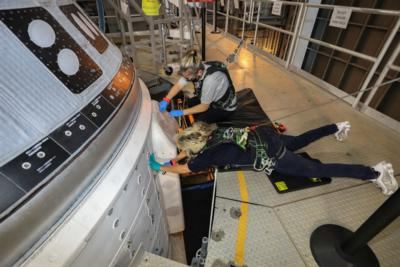
Work progressed to restore functionality to several valves in the Starliner propulsion system that did not open as designed during the launch countdown for the Aug. 3 launch attempt. The valves connect to thrusters that enable abort and in-orbit maneuvering.
With the United Launch Alliance (ULA) Atlas V and Starliner in the Vertical Integration Facility (VIF) near Space Launch Complex-41 on Cape Canaveral Space Force Station in Florida, engineering teams are able to power on Starliner allowing the vehicle to receive commands, and have direct access to the spacecraft for troubleshooting.
Inside the VIF, Boeing has been able to command seven of 13 valves open that previously were in the closed position. Test teams are applying mechanical, electrical and thermal techniques to prompt the valves to open, and are moving forward with a systematic plan to open the remainder of the affected valves, demonstrate repeatable system performance, and verify the root cause of the issue before returning Starliner to the launch pad for its Orbital Flight Test-2 mission.

Boeing also has completed physical inspections and chemical sampling on the exterior of a number of the affected valves, which indicated no signs of damage or external corrosion.
In the coming days, NASA and Boeing will continue work to bring all affected valves into the proper configuration. If all valve functionality can be restored and root cause identified, NASA will work with Boeing to determine a path to flight for the important uncrewed mission to the space station.
NASA, Boeing and ULA are assessing the potential for several launch opportunities with the earliest available in mid-August. Any launch date options would protect for the planetary window for the agency’s Lucy mission – the first-ever mission to explore Trojan asteroids.
More News
“We respectfully call on the City of Mesa to: 1. Withdraw the landing fee proposal immediately 2. Engage with the aviation community before making decisions that impact safet>[...]
High Speed Taxiway A long radius taxiway designed and provided with lighting or marking to define the path of aircraft, traveling at high speed (up to 60 knots), from the runway ce>[...]
Aero Linx: International Federation of Airworthiness (IFA) IFA uniquely combines together all those with responsibility for policies, principles and practices concerned with the co>[...]
Controller’s Expectation That VW02 Would Have Departed Sooner Led To An Inadequate Scan And Loss Of Situational Awareness Analysis: A Robinson R-44 helicopter N744AF, VW02 (V>[...]
A Few Questions AND Answers To Help You Get MORE Out of ANN! 1) I forgot my password. How do I find it? 1) Easy... click here and give us your e-mail address--we'll send it to you >[...]



 Aero-News: Quote of the Day (12.09.25)


 See All