Thu, Dec 11, 2014
Engineering Teams Analyzing Heat Shield, Data Recorders From Flight Test
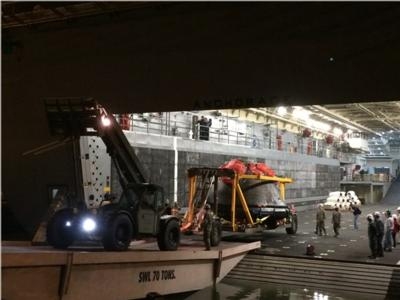
Engineers are getting their first look at the Orion spacecraft following its successful flight test and recovery on Dec. 5. With the spacecraft recovered from the Pacific and brought to port in San Diego, technical teams are examining flight data recorders and samples of the heat shield to learn as much as possible about the performance of key systems during the test.
“The 1,200 on-board sensors will provide us an ocean of information about everything from the effects of space radiation on our avionics to the environment inside the crew cabin,” said Mike Hawes, Lockheed Martin vice president and Orion program manager. “What we learn from this flight will improve Orion’s designs and technology, and help us make future vehicles the best they can be.”
In San Diego engineers have removed samples of the heat shield to examine its performance and ablation rates during re-entry. The samples, along with select data recorders, will be brought to nearby Lockheed Martin facilities for processing. This analysis will help the technical team get a head start in determining how to optimize the development of future heat shields.
Orion will be loaded on a special truck for an estimated two-week trip across the country to Kennedy Space Center in Florida, where NASA and Lockheed Martin engineers will disassemble it and thoroughly examine its structure, computers and instrumentation. In March, as part of the Exploration Flight Test-1 (EFT-1) contract, Lockheed Martin will provide a complete data analysis report to NASA which includes information about the vehicle’s performance and recommendations based on the results.
The EFT-1 crew module will next be used for Ascent Abort Test 2, which is a test of the launch abort system. Orion’s launch abort system is equipped with three powerful motors capable of pulling the capsule and crew a mile up and a mile away from an emergency on the launch pad.
In addition, the Orion team has already begun procuring parts and manufacturing primary structures for the next spacecraft, which will be flown on the upcoming Exploration Mission-1 atop the powerful Space Launch System.
(Image provided by Lockheed Martin)
More News
“We respectfully call on the City of Mesa to: 1. Withdraw the landing fee proposal immediately 2. Engage with the aviation community before making decisions that impact safet>[...]
High Speed Taxiway A long radius taxiway designed and provided with lighting or marking to define the path of aircraft, traveling at high speed (up to 60 knots), from the runway ce>[...]
Aero Linx: International Federation of Airworthiness (IFA) IFA uniquely combines together all those with responsibility for policies, principles and practices concerned with the co>[...]
Controller’s Expectation That VW02 Would Have Departed Sooner Led To An Inadequate Scan And Loss Of Situational Awareness Analysis: A Robinson R-44 helicopter N744AF, VW02 (V>[...]
A Few Questions AND Answers To Help You Get MORE Out of ANN! 1) I forgot my password. How do I find it? 1) Easy... click here and give us your e-mail address--we'll send it to you >[...]



 Aero-News: Quote of the Day (12.09.25)


 See All