Mon, Mar 16, 2015
Enhanced Detection Capabilities And Suppression Of Interference Signals On Its Next Generation Airport Surveillance Radar
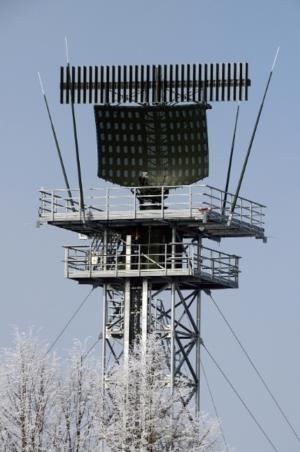
Airbus Defense and Space has introduced new technologies in its latest air surveillance radar which give the ASR-NG (Airport Surveillance Radar Next Generation) advantageous air traffic control capabilities. The company has completed a demonstration in real scenarios in front of international customers which was testament to enhanced detection capabilities with a significant increase of detection range coverage to 120 NM. Other key features of ASR-NG are the complete mitigation of wind farm effects, a new Primary Surveillance Radar 3D height measurement and resistance against interference by 4G/LTE mobile phone signals.
“ASR-NG offers an extraordinary performance proven in an extensive test phase,” said Thomas Müller, head of Airbus Defense and Space’s Electronics business line. “With its new capabilities it addresses the most urgent and recent concerns of air surveillance and air traffic control customers.”
ASR-NG consists of a primary radar on the basis of a solid state transmitter and advanced signal processing technology for long-range surveillance. Its extreme sensitivity means that even very small objects such as mini drones, slow flying objects such as helicopters or even flocks of birds can be reliably detected and classified. Specifically developed algorithms allow for safe guidance of aircraft even in the vicinity of wind turbines, which is hardly possible with conventional air traffic control radar systems.
This extraordinary primary surveillance radar capability is combined with the MSSR 2000I (MSSR = Monopulse Secondary Surveillance Radar) secondary radar for automatic identification of individual aircraft. It meets the new air traffic control standards “Mode S” and “ADS-B”, which greatly improve aircraft identification queries and are currently being introduced in European airspace.
Airbus Defense and Space supplies air traffic control and identification systems in the military and civilian sector. Amongst others, the company equips the German Armed Forces’ airports with the ASR-S (Airport Surveillance Radar, S-Band) airport surveillance radar and delivers a complete approach control system for the military airfields in Switzerland. In addition, the MSSR 2000I secondary radar is deployed by the naval forces of Germany, France, Norway and Finland for military friend-or-foe identification. For civil and military air traffic control, those identification systems are used in countries such as Germany, France, USA, UK, Canada, Austria, Portugal, Bulgaria and the Philippines.
(Image provided by Airbus)
More News
Light Gun A handheld directional light signaling device which emits a brilliant narrow beam of white, green, or red light as selected by the tower controller. The color and type of>[...]
“We have performed extensive ground testing by comparing warm up times, full power tethered pulls, and overall temperatures in 100 degree environments against other aircraft >[...]
While Taxiing To Parking The Right Landing Gear Leg Collapsed, Resulting In Substantial Damage Analysis: The pilot made a normal approach with full flaps and landed on the runway. >[...]
From 2014 (YouTube Edition): Exotic Rebuild Reveals Aerial Work Of Art During EAA AirVenture 2014, ANN's Michael Maya Charles took the time to get a history lesson about a great ai>[...]
Also: Project Talon, McFarlane Acquisition, Sky-Tec Service, JPL Earth Helo Tests Bombardier has earned a round of applause from the business aviation community, celebrating the fo>[...]



 ANN's Daily Aero-Term (12.13.25): Light Gun


 See All