
NASA Succeeds In Filling Phoenix Lander's Oven With Martian Soil | Aero-News Network
Aero-News Network
RSS icon RSS feed
podcast icon MP3 podcast
Subscribe Aero-News e-mail Newsletter Subscribe

Airborne Unlimited -- Most Recent Daily Episodes

Episode Date

Airborne-Monday

Airborne-Tuesday

Airborne-Wednesday Airborne-Thursday

Airborne-Friday

Airborne On YouTube

Airborne-Unlimited-12.08.25

AirborneNextGen-
12.09.25

Airborne-Unlimited-12.10.25

Airborne-AffordableFlyers-12.11.25

AirborneUnlimited-12.12.25

AFE 2025 LIVE MOSAIC Town Hall (Archived): www.airborne-live.net

Wed, Jun 11, 2008

NASA Succeeds In Filling Phoenix Lander's Oven With Martian Soil

"The Ground Moved"

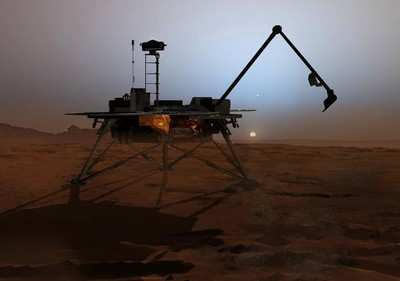
Reason for cheers for scientists at NASA, JPL and the University of Arizona in Tucson Wednesday... as the Phoenix Mars Lander has filled its first oven with Martian soil.

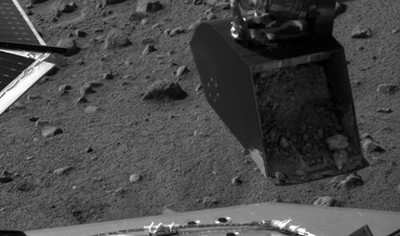
"We have an oven full," Phoenix co-investigator Bill Boynton of the University of Arizona, Tucson, said. "It took 10 seconds to fill the oven. The ground moved."

Boynton leads the Thermal and Evolved-Gas Analyzer instrument, or TEGA, for Phoenix. The instrument has eight separate tiny ovens to bake and sniff the soil to assess its volatile ingredients, such as water.

The lander's Robotic Arm delivered a partial scoopful of clumpy soil from a trench informally called "Baby Bear" to the number 4 oven on TEGA last Friday, June 6, which was 12 days after landing.

A screen covers each of TEGA's eight ovens. The screen is to prevent larger bits of soil from clogging the narrow port to each oven so that fine particles fill the oven cavity, which is no wider than a pencil lead. Each TEGA chute also has a "whirligig" mechanism that vibrates the screen to help shake small particles through.

As ANN reported, NASA experienced difficulties when it first attempted to send Martian soil through the screen, and into the oven. Only a few particles got through when the screen on oven number 4 was vibrated on June 6, 8 and 9.

Boynton said that the oven might have filled because of the cumulative effects of all the vibrating, or because of changes in the soil's cohesiveness as it sat for days on the top of the screen.

"There's something very unusual about this soil, from a place on Mars we've never been before," said Phoenix Principal Investigator Peter Smith of the University of Arizona. "We're interested in learning what sort of chemical and mineral activity has caused the particles to clump and stick together."

Plans prepared by the Phoenix team for the lander's activities on Thursday, June 12 include sprinkling Martian soil on the delivery port for the spacecraft's Optical Microscope and taking additional portions of a high-resolution color panorama of the lander's surroundings.

The Phoenix mission is led by Smith with project management at JPL and development partnership at Lockheed Martin, located in Denver. International contributions come from the Canadian Space Agency; the University of Neuchatel, Switzerland; the universities of Copenhagen and Aarhus, Denmark; Max Planck Institute, Germany; and the Finnish Meteorological Institute.

FMI: www.nasa.gov/phoenix, http://phoenix.lpl.arizona.edu

Advertisement

More News

Aero-News: Quote of the Day (12.09.25)

“We respectfully call on the City of Mesa to: 1. Withdraw the landing fee proposal immediately 2. Engage with the aviation community before making decisions that impact safet>[...]

ANN's Daily Aero-Term (12.09.25): High Speed Taxiway

High Speed Taxiway A long radius taxiway designed and provided with lighting or marking to define the path of aircraft, traveling at high speed (up to 60 knots), from the runway ce>[...]

ANN's Daily Aero-Linx (12.09.25)

Aero Linx: International Federation of Airworthiness (IFA) IFA uniquely combines together all those with responsibility for policies, principles and practices concerned with the co>[...]

NTSB Final Report: Diamond Aircraft Ind Inc DA20C1 (A1); Robinson Helicopter R44

Controller’s Expectation That VW02 Would Have Departed Sooner Led To An Inadequate Scan And Loss Of Situational Awareness Analysis: A Robinson R-44 helicopter N744AF, VW02 (V>[...]

ANN FAQ: Q&A 101

A Few Questions AND Answers To Help You Get MORE Out of ANN! 1) I forgot my password. How do I find it? 1) Easy... click here and give us your e-mail address--we'll send it to you >[...]

blog comments powered by Disqus



Advertisement

Advertisement

Podcasts

Advertisement

© 2007 - 2025 Web Development & Design by Pauli Systems, LC

