
Phoenix Mars Lander Radar, Other Gear Pass Checkouts | Aero-News Network
Aero-News Network
RSS icon RSS feed
podcast icon MP3 podcast
Subscribe Aero-News e-mail Newsletter Subscribe

Airborne Unlimited -- Most Recent Daily Episodes

Episode Date

Airborne-Monday

Airborne-Tuesday

Airborne-Wednesday Airborne-Thursday

Airborne-Friday

Airborne On YouTube

Airborne-Unlimited-12.01.25

AirborneNextGen-
12.02.25

Airborne-Unlimited-12.03.25

Airborne-FltTraining-12.04.25

AirborneUnlimited-12.05.25

AFE 2025 LIVE MOSAIC Town Hall (Archived): www.airborne-live.net

Fri, Sep 07, 2007

Phoenix Mars Lander Radar, Other Gear Pass Checkouts

Spacecraft Has Traveled More Than 50 Million Miles So Far

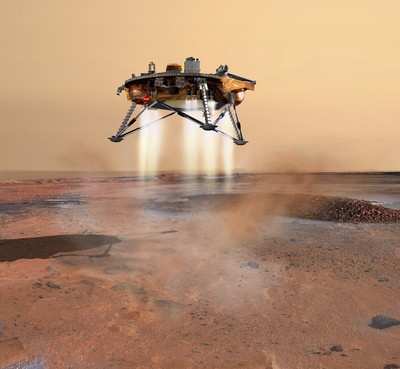
Two crucial tools for a successful landing of America's latest mission to Mars, the radar and UHF radio on the National Aeronautics and Space Administration's Phoenix Mars Lander, have passed in-flight checkouts.

NASA said this week the ultra-high-frequency radio won't be turned on again until landing day, May 25, 2008, when it will relay communications from Phoenix to orbiters already in service around Mars. Since launch on August 4, 2007, and until the day it reaches Mars, Phoenix is communicating directly with Earth via even higher frequency X-band radio, mounted on a part of the spacecraft that will be jettisoned shortly before Phoenix hits the top of the Martian atmosphere.

The radar will monitor the spacecraft's fast-shrinking distance to the ground during the final three minutes before touchdown on Mars, triggering descent-engine firings and other necessary events during the most challenging moments of the mission.

The Phoenix flight operations team tested the radar and UHF radio on Aug. 24. Four days earlier, the team ran the first in-flight checkout of a Phoenix science instrument. This test focused on the Thermal and Evolved-Gas Analyzer, which will check for water, carbon-containing molecules and other chemicals of interest in the icy soil of Mars. The checkout verified the health of an ion pump, which will be used during the transit to Mars to remove most water vapor carried from Earth with the instrument. Four additional science instruments are scheduled for checkouts before the spacecraft's next trajectory correction maneuver, planned for Oct. 16, according to the space agency.

As of September 1, Phoenix will have covered 50 million miles 422-million-mile flight to Mars. It is traveling at 76,000 mph in relation to the sun. Meanwhile, careful preparations continue for the white-knuckle minutes before landing and the potential scientific discoveries at the landing site.

"Everything is going as planned. No surprises, but this is one of those times when boring is good," said Barry Goldstein, Phoenix project manager at NASA's Jet Propulsion Laboratory, Pasadena, CA.

Phoenix will fly to a site farther north than any previous Mars landing. The solar-powered lander will dig into underground ice and will run laboratory tests assessing whether the site could have ever been hospitable to microbial life. The instruments will also look for clues about the history of the water in the ice. They will monitor arctic weather as northern Mars' summer progresses toward fall, until solar energy fades and the mission ends.

FMI: www.jpl.nasa.gov

Advertisement

More News

ANN's Daily Aero-Term (12.04.25): Cooperative Surveillance

Cooperative Surveillance Any surveillance system, such as secondary surveillance radar (SSR), wide-area multilateration (WAM), or ADS-B, that is dependent upon the presence of cert>[...]

ANN's Daily Aero-Linx (12.04.25)

Aero Linx: OX5 Aviation Pioneers Incorporated in 1955 as a Pa 501 (c)(3) Not for Profit Corporation, the OX5 Aviation Pioneers is dedicated to bringing before the public the accomp>[...]

NTSB Prelim: Extra Flugzeugproduktions EA 300/SC

The Pilot Appeared To Regain Control After Six Rotations And Attempted To “Fly Out” Inverted But Had Insufficient Altitude On November 8, 2025, at 1038 eastern standard>[...]

Classic Aero-TV: The Bally Bomber - The All Time Ultimate Warbird Replica?

From 2018 (YouTube Edition): Aero-News Talks With The Airplane's Builder One of the many unique airplanes at AirVenture 2018 was a 1/3-scale B-17 bomber built by Jack Bally, who ta>[...]

ANN's Daily Aero-Linx (12.05.25)

Aero Linx: Society of U.S. Army Flight Surgeons (SoUSAFS) The Society of US Army Flight Surgeons (SoUSAFS) serves to advance the science and art of Aerospace Medicine and its allie>[...]

blog comments powered by Disqus



Advertisement

Advertisement

Podcasts

Advertisement

© 2007 - 2025 Web Development & Design by Pauli Systems, LC

