
USS Wasp First-Ever Carrier To Use JPALS On Deployment | Aero-News Network
Aero-News Network
RSS icon RSS feed
podcast icon MP3 podcast
Subscribe Aero-News e-mail Newsletter Subscribe

Airborne Unlimited -- Most Recent Daily Episodes

Episode Date

Airborne-Monday

Airborne-Tuesday

Airborne-Wednesday Airborne-Thursday

Airborne-Friday

Airborne On YouTube

Airborne-SpecialEpisode-12.15.25

AirborneNextGen-
12.16.25

Airborne-Unlimited-12.10.25

Airborne-AffordableFlyers-12.11.25

AirborneUnlimited-12.12.25

AFE 2025 LIVE MOSAIC Town Hall (Archived): www.airborne-live.net

Sun, Jul 22, 2018

USS Wasp First-Ever Carrier To Use JPALS On Deployment

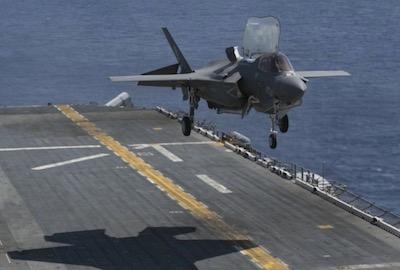
F-35Bs Can Use Joint Precision Approach And Landing System For Precision Landings In Zero Visibility Conditions

Early in 2018, U.S. Marine Corps F-35B Lightning II fighters deployed to the Pacific aboard the USS Wasp amphibious assault ship, and used Raytheon Company's Intelligence, Information and Services business's Joint Precision Approach and Landing System (JPALS) to guide them onto the ship's deck in all weather and surface conditions up to the rough waters of Sea State 5.

The system allows precise landings through GPS receivers and an encrypted, jam-proof datalink.

"We're asking our pilots to land in some of the most difficult conditions on Earth," said U.S. Navy Captain B. Joseph Hornbuckle III, program manager, Naval Air Traffic Management Systems Program Office. "JPALS goes a long way toward ensuring the safety of our aircrews and the success of our missions."

JPAL's precision navigation is equally effective ashore. A land-based version of the system can be small enough to be either dropped into an austere environment via parachute or driven in on a trailer.

"Deploying with the F-35 is a good start, but it's just the beginning," said Matt Gilligan, Raytheon vice president of Navigation, Weather and Services. "There are many fixed and rotary wing aircraft around the world and across the services that deploy to harsh, low-visibility environments where JPALS would be extremely valuable."

The system is slated to go into production in 2019.

(Image provided with Raytheon news release)

FMI: www.raytheon.com

Advertisement

More News

Aero-News: Quote of the Day (12.18.25)

“These new aircraft strengthen our ability to respond quickly, train effectively and support communities nationwide. Textron Aviation has been a steadfast supporter in helpin>[...]

Classic Aero-TV: Viking Twin Otter 400--Bringing the DHC-6 Back Into Production

From 2011 (YouTube Edition): Rugged, Legendary, STOL Twin Makes A Comeback The de Havilland Twin Otter is an airplane with a long history, and it gained a reputation as a workhorse>[...]

NTSB Final Report: Rans Employee Flying Club Rans S-6ES Coyote II

A Wind Gust Lifted The Right Wing And The Airplane Turned To The Left Analysis: The pilot was departing from a 2,395-ft-long by 50-ft-wide turf runway. The pilot reported that afte>[...]

ANN FAQ: Submit a News Story!

Have A Story That NEEDS To Be Featured On Aero-News? Here’s How To Submit A Story To Our Team Some of the greatest new stories ANN has ever covered have been submitted by our>[...]

ANN's Daily Aero-Term (12.18.25): Braking Action Advisories

Braking Action Advisories When tower controllers receive runway braking action reports which include the terms “medium," “poor," or “nil," or whenever weather con>[...]

blog comments powered by Disqus



Advertisement

Advertisement

Podcasts

Advertisement

© 2007 - 2025 Web Development & Design by Pauli Systems, LC

