Fri, Oct 16, 2015
Unit Expansion Expected To Be Completed In About 18 Months
The Air Force currently employs numerous remotely piloted aircraft in support of surveillance and reconnaissance missions throughout deployed locations, with the bulk of these missions are being placed specifically upon the MQ-1 Predator and MQ-9 Reaper aircraft.
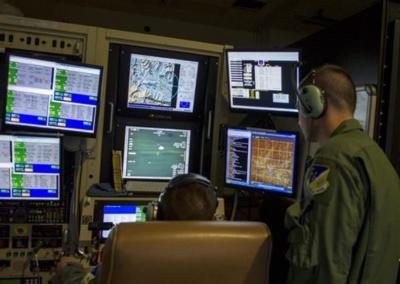
The reliance on the ability for RPAs to fly long hours, and in some situations, support combat missions, has very quickly increased the demand for their use in deployed locations. The proof of this can be seen in the expansion at Holloman Air Force Base's RPA training squadrons.
"By the time we are done with this expansion, Holloman (AFB) will be the largest aircrew training base in the Air Force," said Maj. Christopher, the assistant director of operations for programed flying training.
This expansion will increase the rate of student production from 603 pilots and sensor operator students in fiscal year 2015 up to an estimated 818 students in fiscal 2016.
The formal training unit expansion in total will take about 18 months. This includes training new instructors, expanding facilities and improving syllabi for incoming students. "It takes about six months to create a new instructor," Christopher said. "They have to go through formal instructor upgrade training, and at about the two-month mark, they can start teaching the basics. Four months after that, when they have become a little seasoned, we let them start training in some of the more complex areas."
The expansion promises to fix manning issues within the RPA pilot and sensor operator career fields Air Force-wide. It has also put manning issues for RPA maintainers in the sights of Holloman leadership. "When we started the process, looking at all of the limiting factors, everybody's assumption was that the amount of instructors was the biggest limiting factor," Christopher said. "However, when we started looking at it holistically, we discovered the maintenance manning was even worse than our own."
The realization of the issue for maintainers has led leadership to take the first steps into easing their workload.
There is not yet a set plan, but it is a major topic that is being addressed and will hopefully lead to a lasting fix. "This is probably the best opportunity that has the most investment from leadership in terms of getting us healthy," Christopher said. "It is not a Band-Aid or a quick fix; this seems like leadership is truly focused on a long-term sustainable fix that is going to keep the RPA community healthy as a whole and keep us there. It is going to hurt for a little while because we have got a lot of work to do, but the demand is still there and we need to do our best to meet that."
ANN Salutes Senior Airman Chase Cannon, 49th Wing Public Affairs
(USAF Image)
More News
Light Gun A handheld directional light signaling device which emits a brilliant narrow beam of white, green, or red light as selected by the tower controller. The color and type of>[...]
“We have performed extensive ground testing by comparing warm up times, full power tethered pulls, and overall temperatures in 100 degree environments against other aircraft >[...]
While Taxiing To Parking The Right Landing Gear Leg Collapsed, Resulting In Substantial Damage Analysis: The pilot made a normal approach with full flaps and landed on the runway. >[...]
From 2014 (YouTube Edition): Exotic Rebuild Reveals Aerial Work Of Art During EAA AirVenture 2014, ANN's Michael Maya Charles took the time to get a history lesson about a great ai>[...]
Also: Project Talon, McFarlane Acquisition, Sky-Tec Service, JPL Earth Helo Tests Bombardier has earned a round of applause from the business aviation community, celebrating the fo>[...]



 ANN's Daily Aero-Term (12.13.25): Light Gun


 See All