
Solar Impulse2 Diverts To Nagoya Japan On Its Way To Hawaii | Aero-News Network
Aero-News Network
RSS icon RSS feed
podcast icon MP3 podcast
Subscribe Aero-News e-mail Newsletter Subscribe

Airborne Unlimited -- Most Recent Daily Episodes

Episode Date

Airborne-Monday

Airborne-Tuesday

Airborne-Wednesday Airborne-Thursday

Airborne-Friday

Airborne On YouTube

Airborne-Unlimited-11.24.25

AirborneNextGen-
11.18.25

Airborne-Unlimited-11.19.25

Airborne-AffordableFlyers-11.20.25

AirborneUnlimited-11.21.25

LIVE MOSAIC Town Hall (Archived): www.airborne-live.net

Mon, Jun 01, 2015

Solar Impulse2 Diverts To Nagoya Japan On Its Way To Hawaii

SI2 Will Have To Wait For Better Weather Before Completing Leg To Hawaii

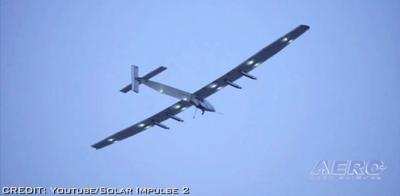
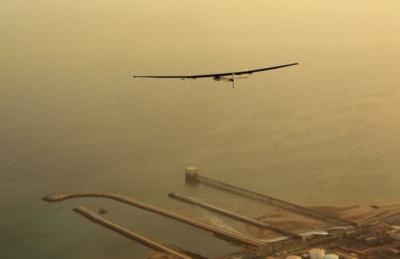
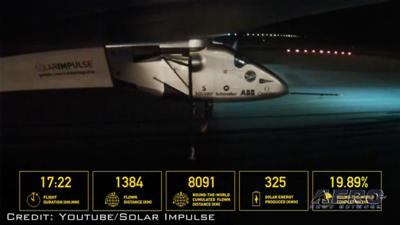
The 6 day and night exploration flight of the all-electric Solar Impulse-two commenced from Nanjing, China to Hawaii on Saturday, but after about 36 hours of flight, bad weather has forced the Pilot André Borschberg to return to Nagoya, Japan until weather improves.


The flight had progressed to a point east of Japan when flight controllers determined that the weather window to reach Hawaii had closed. The team said in a statement, "The cold front is too dangerous to cross, so we have decided to land in Nagoya airfield, and wait for better weather conditions in order to continue."

Despite the decision to postpone the long overwater flight to Hawaii, that the team reported that the aircraft is performing well and they are satisfied with the ability of the solar cells to recharge the batteries after prolonged night flight.

The Solar Impulse2 program, being flown alternately by pilots Bertrand Piccard and André Borschberg, has thus far finished 6 primary legs of a flight around the world in a vehicle that is fueled only by electrical energy captured from sunlight.

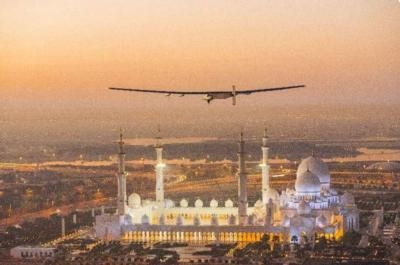
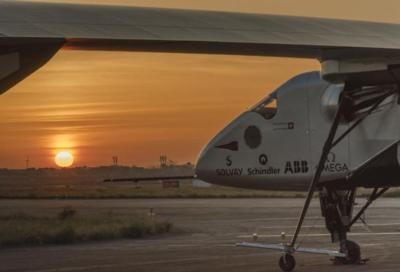
The single seat SI2 is made of carbon fiber, with a 72 meter wingspan (larger than that of the Boeing 747-8I) and adds up to a weight of just 2,300 Kg -- just a bit over 5070 pounds. The 17,000 solar cells built into the wing supply four 17.5 CV electric motors with 'fuel.'

During the day, the solar cells recharge 2077 lbs lithium batteries allowing the aircraft to fly at night until the next day when the recharging cycle can begin anew.

ANN is monitoring the flight closely and will keep you apprised as André makes his way to Hawaii.

FMI: www.solarimpulse.com


Advertisement

More News

ANN's Daily Aero-Term (11.28.25): Unmanned Aircraft System (UAS)

Unmanned Aircraft System (UAS) An unmanned aircraft and its associated elements related to safe operations, which may include control stations (ground, ship, or air based), control>[...]

ANN's Daily Aero-Linx (11.28.25)

Aero Linx: Cactus Fly-In The Classic Airplane Association of Arizona, Inc. (CAAA) was incorporated in Arizona as a not for profit corporation on January 10, 2014. The CAAA roster i>[...]

Airborne 11.21.25: NTSB on UPS Accident, Shutdown Protections, Enstrom Update

Also: UFC Buys Tecnams, Emirates B777-9 Buy, Allegiant Pickets, F-22 And MQ-20 The NTSB's preliminary report on the UPS Flight 2976 crash has focused on the left engine pylon's sep>[...]

Airborne 11.26.25: Bonanza-Baron Fini, Archer v LA NIMBYs, Gogo Loses$$$

Also: Bell 505 on SAF, NYPA Gets Flak For BizAv 'Abuse', FAA Venezuela Caution, Horizon Update Textron Aviation has confirmed it will be ending production of the Beechcraft Bonanza>[...]

Airborne-NextGen 11.25.25: EHang Manned Flt, Army UAVs, Starship V3 Booster Boom

Also: FedEx SAF, Archer Midnight Powertrain Tech, Rocket Lab Record, Perseverance Rover Find EHang has logged a major milestone in the development of its pilotless air taxi, loggin>[...]

blog comments powered by Disqus



Advertisement

Advertisement

Podcasts

Advertisement

© 2007 - 2025 Web Development & Design by Pauli Systems, LC

