Aircraft Certification Adds 270 Pounds Of Payload Capabilities
The FAA has approved an increased maximum gross weight of 6,770 for the MD Explorer 902 helicopter. The company announced the change at Heli-Expo in Las Vegas Tuesday. The extra payload of 270 pounds allows operators in every market segment to further leverage the superior mission capabilities of this versatile aircraft.
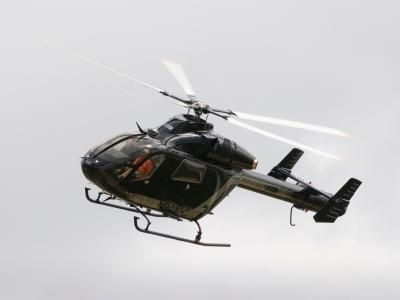
“We are pleased that the certification is complete,” said Carl Schopfer, President of MDHI. “The approval paves the way for a new set of equipment and technology configurations that will raise the mission versatility of the Explorer 902 to new heights for our operators. While the capabilities of the aircraft have always been superior, the certification confirms the MD Explorer’s position as the world’s most capable light twin.”
Powered by two Pratt and Whitney Canada PW207E engines, the MD Explorer features a fully articulated main rotor system, bearingless composite flexbeams and rotor hub. Anti-torque control is provided by the revolutionary NOTAR system that reduces pilot workload, external noise levels and significantly improves safety in confined areas and on offshore platforms. The six-place MD Explorer cabin is accessed through two 52 inch (1.32m) sliding cabin doors and a large baggage compartment. Energy absorbing, stroking cabin seats meet stringent FAR Part 27.562 requirements up to 30g at 30 feet per second. The large cabin makes the MD Explorer ideally suited for rapid role change from an Offshore/Onshore six-place passenger transport to Emergency Medical Services or Law Enforcement missions. Large selections of optional equipment have been fully qualified to meet various operational requirements. A heavy-duty cargo hook permits more than 3,000-pound (1360-KG) external load operations.
MD Explorer safety and maintainability are enhanced by built-in HIRF and lightning strike protection, built-in maintenance steps and platforms, and an advanced composite airframe that is resistant to corrosion in a hostile marine environment.
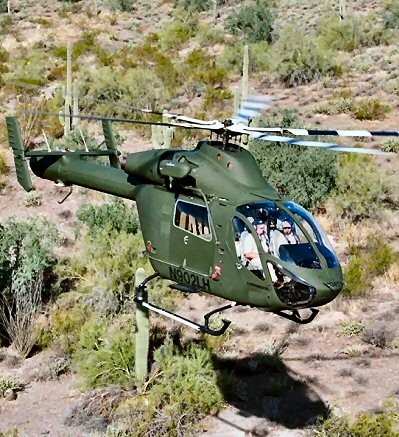
The aircraft has been around for some time. The company said at Heli-Expo that it is celebrating 20 years of the Explorer model helicopter. The MD Explorer 900 completed its maiden flight Dec. 18, 1992, setting benchmarks for performance and safety advancements, in the light twin category. The Explorer was the first production aircraft to incorporate the revolutionary NOTAR system in its initial design. The company says that with 20 years of mission proven flight, the advanced design of the airframe combined with NOTAR technology, still sets the bar for quiet operation, safety, versatility and low cost operation.
“Twenty years ago, the MD Explorer introduced the world to the future of rotorcraft design,” said Ms. Lynn Tilton, CEO of MDHI. “Still today, the MD Explorer boasts the most advanced airframe in the light twin category, and the many significant advantages exclusive to NOTAR technology. On behalf of the men and women who worked tirelessly to develop this aircraft and our exceptional group of operators that depend on the Explorer 902 to accomplish critical missions, we celebrate this most important 20th anniversary milestone. ”
Development of the aircraft began in January 1989, with McDonnell Douglas Helicopters. FAA certification for the Explorer 900 was granted in 1994, with JAA certification following shortly thereafter. In Sep.1997, the Explorer 902 was introduced with enhancements including an improved NOTAR inlet design and a more powerful stabilizer control system. The benefits of these changes included improved range and endurance, and an increased maximum takeoff weight. With exclusive NOTAR anti-torque technology, MD Helicopters, including the Explorer 902, continue to be the only helicopters in the world to operate without a tail rotor, an extraordinary safety and noise reduction advantage.
(Images provided by MD Helicopter)



 ANN's Daily Aero-Term (12.04.25): Cooperative Surveillance


 See All