
NEAT Tests Megawatt-Scale Electric Aircraft Power Systems | Aero-News Network
Aero-News Network
RSS icon RSS feed
podcast icon MP3 podcast
Subscribe Aero-News e-mail Newsletter Subscribe

Airborne Unlimited -- Most Recent Daily Episodes

Episode Date

Airborne-Monday

Airborne-Tuesday

Airborne-Wednesday Airborne-Thursday

Airborne-Friday

Airborne On YouTube

Airborne-SpecialEpisode-12.15.25

AirborneNextGen-
12.16.25

Airborne-Unlimited-12.10.25

Airborne-AffordableFlyers-12.11.25

AirborneUnlimited-12.12.25

AFE 2025 LIVE MOSAIC Town Hall (Archived): www.airborne-live.net

Sat, Jun 01, 2019

NEAT Tests Megawatt-Scale Electric Aircraft Power Systems

NASA Electric Aircraft Testbed Will Work On Electric-Powered Airliners

As large airline companies compete to reduce emissions, fuel and noise, aircraft manufacturers are shifting more of their aircraft systems to electrical power. To help usher in the next revolution in aviation— hybrid electric and turboelectric aircraft – NASA is building and testing portions of a concept aircraft’s power systems with an eye toward the future.

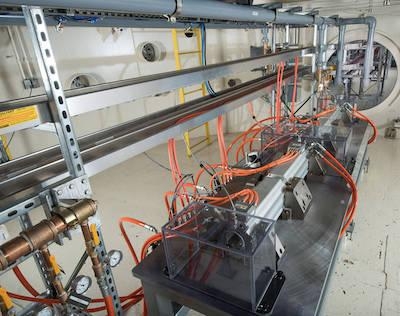
NASA Glenn has repurposed its Hypersonic Tunnel Facility to create the NASA Electric Aircraft Testbed (NEAT). Located at Plum Brook Station in Sandusky, Ohio, NEAT is a world-class, reconfigurable facility that can accommodate power systems for large passenger airplanes like a Boeing 737, with megawatts of power. This testbed, which recently conducted its first megawatt-scale test, takes advantage of the facility’s massive amounts of available power to carry out research and technology development of aircraft electrical powertrains – like the power system seen here.

“We can layout an entire electric powertrain, not including the engines, in NEAT and test all of the key electrical systems for an electrified aircraft,” says Dr. Rodger Dyson, principal investigator.

NEAT also includes a vacuum chamber, where this photo perspective was taken from, which can currently simulate altitudes of up to 40,000 feet to test high-voltage power electronics, electric motors, and controls. Within the year, NASA plans to increase the altitude capability to over 50,000 feet.

“NEAT can make a difference in aviation because it has the power and size to investigate the full power capabilities of the next generation of hybrid and turboelectric aircraft,” says Dyson.

(Image provided with NASA news release)

FMI: www.nasa.gov

Advertisement

More News

ANN's Daily Aero-Term (12.13.25): Light Gun

Light Gun A handheld directional light signaling device which emits a brilliant narrow beam of white, green, or red light as selected by the tower controller. The color and type of>[...]

Aero-News: Quote of the Day (12.13.25)

“We have performed extensive ground testing by comparing warm up times, full power tethered pulls, and overall temperatures in 100 degree environments against other aircraft >[...]

NTSB Final Report: Gippsland GA-8

While Taxiing To Parking The Right Landing Gear Leg Collapsed, Resulting In Substantial Damage Analysis: The pilot made a normal approach with full flaps and landed on the runway. >[...]

Classic Aero-TV: Historically Unique -- Marlin Horst's Exquisite Fairchild 71

From 2014 (YouTube Edition): Exotic Rebuild Reveals Aerial Work Of Art During EAA AirVenture 2014, ANN's Michael Maya Charles took the time to get a history lesson about a great ai>[...]

Airborne 12.12.25: Global 8000, Korea Pilot Honors, AV-30 Update

Also: Project Talon, McFarlane Acquisition, Sky-Tec Service, JPL Earth Helo Tests Bombardier has earned a round of applause from the business aviation community, celebrating the fo>[...]

blog comments powered by Disqus



Advertisement

Advertisement

Podcasts

Advertisement

© 2007 - 2025 Web Development & Design by Pauli Systems, LC

