

Rocket Lab Lands $816M Contract for Missile-Tracking Satellites | Aero-News Network
Aero-News Network
RSS icon RSS feed
podcast icon MP3 podcast
Subscribe Aero-News e-mail Newsletter Subscribe

Airborne Unlimited -- Most Recent Daily Episodes

Episode Date

Airborne-Monday

Airborne-Tuesday

Airborne-Wednesday Airborne-Thursday

Airborne-Friday

Airborne On YouTube

Airborne-Unlimited-12.22.25

AirborneNextGen-
12.23.25

Airborne-Unlimited-12.10.25

Airborne-FltTraining-12.18.25

AirborneUnlimited-12.19.25

AFE 2025 LIVE MOSAIC Town Hall (Archived): www.airborne-live.net

Wed, Dec 24, 2025

Rocket Lab Lands $816M Contract for Missile-Tracking Satellites

Tranche 3 Award Grows the Company’s Role in US National Security Space

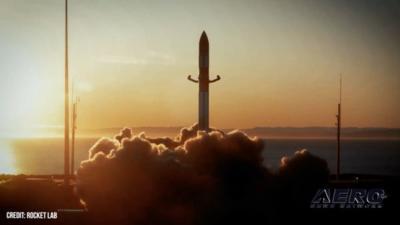
Rocket Lab has earned its largest single contract to date, receiving $816 million from the US Space Development Agency to build 18 missile-tracking satellites for the Space Force’s Tracking Layer Tranche 3 program. The award covers the design and production of spacecraft intended to detect and track advanced missile threats, including hypersonic weapons.

The contract includes a $806 million base award plus up to $10.45 million in options. The satellites will be part of the Proliferated Warfighter Space Architecture, which is a layered constellation designed to provide persistent global coverage rather than relying on a small number of high-value assets. Rocket Lab will act as a prime contractor, filling a role traditionally reserved for much larger defense firms.

“Rocket Lab is honored to play a role in enabling this,” said Rocket Lab Founder and CEO Peter Beck. “Demand for resilient, scalable, and affordable space systems continues to grow, and this award demonstrates that Rocket Lab is uniquely positioned to lead the charge in delivering solutions that meet the needs of national security.”

Each satellite will carry Rocket Lab’s Phoenix infrared payload, a wide-field-of-view sensor developed specifically for missile warning and tracking missions. The spacecraft will also be equipped with the company’s StarLite protection sensors, designed to detect and respond to directed-energy threats. StarLite has been selected by other Tracking Layer primes as well, giving Rocket Lab a secondary role as a supplier beyond its own satellites.

The spacecraft will be built on Rocket Lab’s Lightning satellite platform and produced using the company’s vertically integrated manufacturing model. Major systems, including avionics, propulsion, payloads, solar arrays, reaction wheels, and software, are designed and built in-house to prioritize production speed and cost control over the traditional subcontract-heavy approach.

This award builds on Rocket Lab’s earlier $515 million SDA contract to deliver 18 satellites for the Transport Layer Tranche 2 program, bringing its total SDA contract value to more than $1.3 billion. The Transport Layer satellites support low-latency military communications and are already in production.

FMI: www.rocketlabcorp.com

Advertisement

More News

Classic Aero-TV: In Praise of Alabama’s Patriot Aircraft USA

From 2023 (YouTube Edition): "Ain’t Your Daddy’s Super Cub”—Don Wade Co-owned by Don and Ron Wade—the former of Don’s Dream Machines, a storied >[...]

NTSB Final Report: Cirrus Design Corp SR22

Pilot-Rated Passenger Reported That The Pilot Did Not Adequately “Round Out” The Landing Flare And The Airplane Bounced And Yawed To The Right Analysis: The pilot state>[...]

ANN's Daily Aero-Term (12.21.25): Dead Reckoning

Dead Reckoning Dead reckoning, as applied to flying, is the navigation of an airplane solely by means of computations based on airspeed, course, heading, wind direction, and speed,>[...]

ANN's Daily Aero-Linx (12.21.25)

Aero Linx: Lake Amphibian Club This website is created and sponsored by the Lake Amphibian Club, to help spread the word about these wonderful, versatile amphibians that can land j>[...]

Aero-News: Quote of the Day (12.21.25)

“I am deeply honored to be sworn in as NASA administrator. NASA’s mission is as imperative and urgent as ever — to push the boundaries of human exploration, ignit>[...]

blog comments powered by Disqus



Advertisement

Advertisement

Podcasts

Advertisement

© 2007 - 2025 Web Development & Design by Pauli Systems, LC

