
U.S. Cargo Spacecraft Wraps Up Its First Station Resupply Mission | Aero-News Network
Aero-News Network
RSS icon RSS feed
podcast icon MP3 podcast
Subscribe Aero-News e-mail Newsletter Subscribe

Airborne Unlimited -- Most Recent Daily Episodes

Episode Date

Airborne-Monday

Airborne-Tuesday

Airborne-Wednesday Airborne-Thursday

Airborne-Friday

Airborne On YouTube

Airborne-SpecialEpisode-12.15.25

AirborneNextGen-
12.16.25

Airborne-Unlimited-12.10.25

Airborne-AffordableFlyers-12.11.25

AirborneUnlimited-12.12.25

AFE 2025 LIVE MOSAIC Town Hall (Archived): www.airborne-live.net

Wed, Feb 19, 2014

U.S. Cargo Spacecraft Wraps Up Its First Station Resupply Mission

Will Burn Up On Re-Entry Over The Pacific Ocean

Orbital Sciences Corporation’s Cygnus spacecraft, which delivered  nearly one-and-a-half tons of supplies and scientific equipment to the International Space Station in January, completed its first commercial cargo mission to the orbiting laboratory Tuesday.

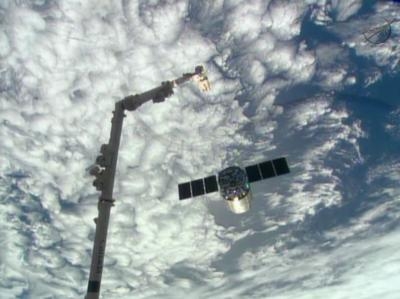
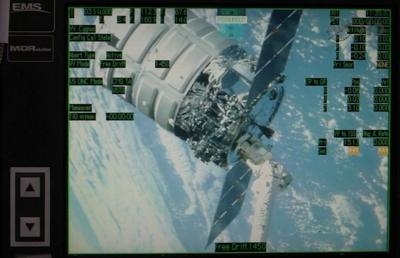
NASA astronaut Mike Hopkins, with assistance from Japan Aerospace Exploration Agency astronaut Koichi Wakata, used the station’s 57-foot Canadarm2 robotic arm to detach Cygnus from the Earth-facing port of the Harmony node at 5:15 a.m. EST.  While Wakata monitored data and kept in contact with the team at Houston’s Mission Control Center, Hopkins released Cygnus from the robotic arm at 6:41 a.m.

At the time of release, the station was orbiting about 260 miles over the southern Atlantic Ocean off the southeast coast of Argentina and Uruguay. From their vantage point inside the station’s cupola observation deck, the two flight engineers monitored telemetry from Cygnus as the unpiloted resupply ship -- now loaded with trash -- conducted a 1-minute, 30-second departure burn to move a safe distance away from the station.

The U.S. commercial cargo craft will begin its deorbit sequence shortly after 8 a.m. Wednesday to enable it to slip out of orbit for a destructive entry into Earth's atmosphere. Cygnus will burn up over the Pacific Ocean later that afternoon.

During its first official commercial resupply mission, designated Orbital-1, Cygnus delivered 2,780 pounds of supplies to the space station, including vital science experiments for the Expedition 38 crew. Cygnus launched from NASA’s Wallops Flight Facility on Jan. 9 aboard an Orbital Sciences Antares rocket and arrived at the complex Jan. 12.

(Images provided by NASA)

FMI www.nasa.gov


Advertisement

More News

ANN's Daily Aero-Term (12.19.25): Ultrahigh Frequency (UHF)

Ultrahigh Frequency (UHF) The frequency band between 300 and 3,000 MHz. The bank of radio frequencies used for military air/ground voice communications. In some instances this may >[...]

NTSB Prelim: Cirrus Design Corp SR22T

During The 7 Second Descent, There Was Another TAWS Alert At Which Time The Engine Remained At Full Power On October 24, 2025 at 2115 mountain daylight time, a Cirrus SR22T, N740TS>[...]

Classic Aero-TV: The Red Tail Project--Carrying the Torch of the Tuskegee Airmen

From 2009 (YouTube Edition): Educational Organization Aims to Inspire by Sharing Tuskegee Story Founding leader Don Hinz summarized the Red Tail Project’s mission in simple, >[...]

Aero-News: Quote of the Day (12.19.25)

“This feels like an important step since space travel for people with disabilities is still in its very early days... I’m so thankful and hope it inspires a change in m>[...]

Airborne 12.17.25: Skydiver Hooks Tail, Cooper Rotax Mount, NTSB v NDAA

Also: New Katanas, Kern County FD Training, IndiGo’s Botched Roster, MGen. Leavitt Named ERAU Dean The Australian Transportation Safety Bureau (ATSB) has wrapped up its inves>[...]

blog comments powered by Disqus



Advertisement

Advertisement

Podcasts

Advertisement

© 2007 - 2025 Web Development & Design by Pauli Systems, LC

