Subjects Range From Huge Gas Giant To Organic Molecules
Gas giant Jupiter, organic molecules in star-forming clouds and baby galaxies in the distant Universe are among the first targets for which data will be immediately available from the James Webb Space Telescope once it begins casting its powerful gaze on the Universe in 2019.
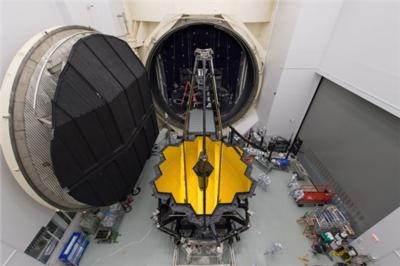
Thirteen “early release” programs were chosen from more than 100 proposals after a competitive peer-review selection process within the astronomical community. The programs have been allocated nearly 500 hours of observing time and will exercise all four of Webb’s state-of-the-art science instruments. The data will be made publicly available immediately, showcasing the full potential of the observatory and allowing astronomers to best plan follow-up observations.
Webb is an international partnership between NASA, ESA and the Canadian Space Agency. As well as providing the Ariane rocket that will launch the observatory in 2019, Europe is contributing to two of the four scientific instruments.
Four of the first sets of observations announced today are led by scientists from ESA member states. “We were impressed by the high quality of the proposals received. These programs will not only generate great science, but will also be a unique resource for demonstrating the investigative capabilities of this extraordinary observatory to the worldwide scientific community,” said Ken Sembach, director of the Space Telescope Science Institute (STScI) in Baltimore, MD.
“We want the research community to be as scientifically productive as possible, as early as possible, which is why I am so pleased to be able to dedicate nearly 500 hours of director’s discretionary time to these early release science observations.”
“It is exciting to see the engagement of the astronomical community in designing and proposing what will be the first scientific programs for the James Webb Space Telescope,” said Alvaro Gimenez, ESA Director of Science. “Webb will revolutionise our understanding of the Universe and the results that will come out from these early observations will mark the beginning of a thrilling new adventure in astronomy.”
During its mission of a minimum of five years Webb will address key topics in modern astronomy, probing the Universe beyond what its precursor, the Hubble Space Telescope, can see.
Its observing goals include detecting the first galaxies in the Universe and following their evolution over cosmic time, including ‘weighing’ supermassive black holes that lurk in their centres. It will build on observations made by the Hubble Space Telescope, examining galaxies whose light has been stretched into infrared wavelengths by the expansion of space – beyond what Hubble can see – giving astronomers new insights into these galaxy cornucopias.
Webb will also witness the birth of new stars and their planetary systems, and study planets in our Solar System and around other stars to better understand the origin of life here on Earth. The space observatory will be able to analyse the composition of exoplanet atmospheres, which could provide hints of a planet’s potential habitability. Astronomers will initially train their gaze onto gaseous Jupiter-sized worlds, which will pave the way for studies of smaller super-Earths.
“I’m thrilled to see the list of astronomers’ most fascinating targets for the Webb telescope, and extremely eager to see the results. We fully expect to be surprised by what we find,” said John C. Mather, Senior Project Scientist for the Webb telescope and Senior Astrophysicist at NASA’s Goddard Space Flight Center, Greenbelt, Maryland.
The selection of the first programs is part of the STScI Director’s Discretionary Early Release Science initiative aimed at providing the entire scientific community with early access to Webb data.
(Image provided with ESA news release)



 ANN's Daily Aero-Term (12.13.25): Light Gun


 See All