
AOPA Looking For Alternatives To New Mexico Special-Use Airspace Restrictions | Aero-News Network
Aero-News Network
RSS icon RSS feed
podcast icon MP3 podcast
Subscribe Aero-News e-mail Newsletter Subscribe

Airborne Unlimited -- Most Recent Daily Episodes

Episode Date

Airborne-Monday

Airborne-Tuesday

Airborne-Wednesday Airborne-Thursday

Airborne-Friday

Airborne On YouTube

Airborne-SpecialEpisode-12.15.25

AirborneNextGen-
12.16.25

Airborne-Unlimited-12.10.25

Airborne-AffordableFlyers-12.11.25

AirborneUnlimited-12.12.25

AFE 2025 LIVE MOSAIC Town Hall (Archived): www.airborne-live.net

Tue, Feb 22, 2005

AOPA Looking For Alternatives To New Mexico Special-Use Airspace Restrictions

Organization Says Training Initiative Would Be Dangerous To GA Pilots

AOPA has voiced its opposition to parts of a New Mexico Training Range Initiative that would expand military airspace in a way that creates safety hazards for general aviation.

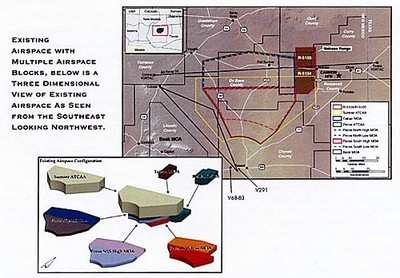
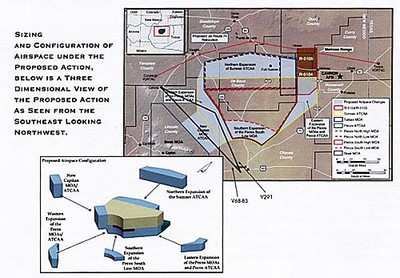
The proposal by the 27th Fighter Wing at Cannon Air Force Base would expand Melrose Air Force Range by creating a new Capitan MOA/ATC Assigned Airspace (ATCAA) and enlarging the existing Pecos MOAs, which are approved for lights-out training. The proposal would allow supersonic flight at common general aviation altitudes.

"AOPA is gravely concerned with the potential impact on flight safety if general aviation air traffic is forced to 'see and avoid' F-16s maneuvering at supersonic airspeeds," said Heidi Williams, AOPA director of air traffic services, in comments to the Air Force. "Such a situation presents undeniable risks to flight safety for both military and general aviation pilots."

AOPA has recommended that the Air Force adopt an alternative detailed in the draft environmental impact statement (EIS) that would expand the Pecos High and Low MOAs but not create the Capitan MOA/ATCAA. This option would allow general aviation pilots to efficiently deviate around the expanded special-use airspace (SUA) complex without creating additional flight safety concerns associated with the Capitan.
AOPA also requested that the Air Force analyze the impact that expanding lights-out and supersonic operations would have on the flight safety of general aviation aircraft operating in the same airspace.

In its entirety, the proposal would drop the floor for supersonic flight from 30,000 feet to 10,000 feet mean sea level (msl), which is approximately 5,000 to 6,000 feet above ground level (agl) - altitudes frequently used by much slower general aviation aircraft. It also would expand military lights-out operations in the Pecos MOAs.

AOPA opposes the creation of the Capitan MOA because it restricts VFR and IFR traffic flying between Roswell, New Mexico, and points to the northwest.
The creation of the Capitan MOA, which typically would be active approximately two hours a day about 24 days a year, would compress IFR traffic into a narrow 3,500-foot-tall corridor along V68-83. A small portion of the airway below 12,500 feet would be the only airway available for IFR transitions around an SUA complex encompassing nearly 3,300 square miles.

Expansion of the Pecos MOAs to the west would impact V291, which also runs between the Corona VOR and Roswell, essentially closing the airway every weekday for most of the day.

This would force pilots flying between Roswell and Albuquerque to fly under, or deviate 176 nautical miles around, the MOAs. Most general aviation pilots would deviate. A 2003 survey of AOPA members showed that 73 percent of them deviated around MOAs in part because of the lack of accurate real-time status information on that airspace.

The Air Force is seeking comments through February 21 on the EIS. Comments on the proposed SUA expansion should be sent to:

Ms. Brenda Cook
HZ ACC/CEVP
129 Andrews St., Ste 102
Langley AFB, VA 23665-2769

FMI: www.cannon.af.mil/NMTRI%20Draft%20EIS_red.pdf

Advertisement

More News

ANN's Daily Aero-Term (12.19.25): Ultrahigh Frequency (UHF)

Ultrahigh Frequency (UHF) The frequency band between 300 and 3,000 MHz. The bank of radio frequencies used for military air/ground voice communications. In some instances this may >[...]

NTSB Prelim: Cirrus Design Corp SR22T

During The 7 Second Descent, There Was Another TAWS Alert At Which Time The Engine Remained At Full Power On October 24, 2025 at 2115 mountain daylight time, a Cirrus SR22T, N740TS>[...]

Classic Aero-TV: The Red Tail Project--Carrying the Torch of the Tuskegee Airmen

From 2009 (YouTube Edition): Educational Organization Aims to Inspire by Sharing Tuskegee Story Founding leader Don Hinz summarized the Red Tail Project’s mission in simple, >[...]

Aero-News: Quote of the Day (12.19.25)

“This feels like an important step since space travel for people with disabilities is still in its very early days... I’m so thankful and hope it inspires a change in m>[...]

Airborne 12.17.25: Skydiver Hooks Tail, Cooper Rotax Mount, NTSB v NDAA

Also: New Katanas, Kern County FD Training, IndiGo’s Botched Roster, MGen. Leavitt Named ERAU Dean The Australian Transportation Safety Bureau (ATSB) has wrapped up its inves>[...]

blog comments powered by Disqus



Advertisement

Advertisement

Podcasts

Advertisement

© 2007 - 2025 Web Development & Design by Pauli Systems, LC

