Thu, Jun 16, 2011
Orbit Insertion Is Expected July 16
Scientists working with NASA's Dawn spacecraft have created a
new video showing the giant asteroid Vesta as the spacecraft
approaches this unexplored world in the main asteroid belt. The
video loops 20 images obtained for navigation purposes on June 1.
The images show a dark feature near Vesta's equator moving from
left to right across the field of view as Vesta rotates. Images
also show Vesta's jagged, irregular shape, hinting at the enormous
crater known to exist at Vesta's south pole.
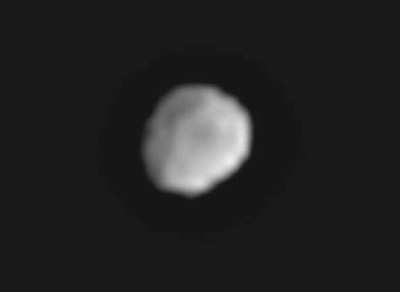
Capture From NASA Video
The images were obtained by a framing
camera during a 30-minute period and show about 30 degrees of a
rotation. The pixel size in these images is approaching the
resolution of the best Hubble Space Telescope images of Vesta.
"Like strangers in a strange land, we're looking for familiar
landmarks," said Jian-Yang Li, a Dawn participating scientist from
the University of Maryland, College Park. "The shadowy spot is one
of those -- it appears to match a feature, known as 'Feature B,'
from images of Vesta taken by NASA's Hubble Space Telescope."
Before orbiting Vesta on July 16, Dawn will gently slow down to
about 75 mph. NASA is expecting to release more images on a weekly
basis, with more frequent images available once the spacecraft
begins collecting science at Vesta.
"Vesta is coming more and more into focus," said Andreas Nathues,
framing camera lead investigator, based at the Max Planck Institute
for Solar System Research, Katlenburg-Lindau, Germany. "Dawn's
framing camera is working exactly as anticipated."

NASA Image
The Dawn mission is managed by NASA's
Jet Propulsion Laboratory in Pasadena, Calif., for the agency's
Science Mission Directorate in Washington. Dawn is a project of the
directorate's Discovery Program, managed by NASA's Marshall Space
Flight Center in Huntsville, Ala. UCLA is responsible for overall
Dawn mission science. Orbital Sciences Corp. of Dulles, Va.,
designed and built the Dawn spacecraft. The framing cameras were
developed and built under the leadership of the Max Planck
Institute for Solar System Research in Katlenburg-Lindau, Germay.
The German Aerospace Center (DLR) Institute of Planetary Research
in Berlin made significant contributions in coordination with the
Institute of Computer and Communication Network Engineering in
Braunschweig. The framing camera project is funded by the Max
Planck Society, DLR and NASA. JPL is a division of the California
Institute of Technology in Pasadena.
More News
Light Gun A handheld directional light signaling device which emits a brilliant narrow beam of white, green, or red light as selected by the tower controller. The color and type of>[...]
“We have performed extensive ground testing by comparing warm up times, full power tethered pulls, and overall temperatures in 100 degree environments against other aircraft >[...]
While Taxiing To Parking The Right Landing Gear Leg Collapsed, Resulting In Substantial Damage Analysis: The pilot made a normal approach with full flaps and landed on the runway. >[...]
From 2014 (YouTube Edition): Exotic Rebuild Reveals Aerial Work Of Art During EAA AirVenture 2014, ANN's Michael Maya Charles took the time to get a history lesson about a great ai>[...]
Also: Project Talon, McFarlane Acquisition, Sky-Tec Service, JPL Earth Helo Tests Bombardier has earned a round of applause from the business aviation community, celebrating the fo>[...]



 ANN's Daily Aero-Term (12.13.25): Light Gun


 See All