Tue, Jun 16, 2009
NTSB Releases Probable Cause Report
 The NTSB has released its probable cause report for a mid-air
collision in January, 2008 which killed four people in two aircraft
and one on the ground. The incident, which happened January 20th of
last year, involved a Cessna 150, piloted by 24-year-old
Anthony Guzman, and a Cessna 172, flown by 73-year-old Paul Carson.
Both pilots were instrument rated, though the accident happened
under VFR conditions.
The NTSB has released its probable cause report for a mid-air
collision in January, 2008 which killed four people in two aircraft
and one on the ground. The incident, which happened January 20th of
last year, involved a Cessna 150, piloted by 24-year-old
Anthony Guzman, and a Cessna 172, flown by 73-year-old Paul Carson.
Both pilots were instrument rated, though the accident happened
under VFR conditions.
The NTSB found:
A Cessna 172N and a Cessna 150M collided in-flight while
maneuvering 1.4 miles southwest of the uncontrolled airport during
day visual meteorological conditions. The midair collision occurred
about 2 minutes after the Cessna 150M had taken off from runway 25,
turned crosswind, and was entering on the downwind leg.
Radar data shows that during this time, a Cessna 172N completed
a course change maneuver and was proceeding inbound toward the
airport on a 034-degree true course, which approximated the
45-degree traffic pattern's entry path to the downwind leg. The
north-northeast-bound Cessna 172N impacted the right side of the
southeast-bound Cessna 150M after the airplanes were flying on
converging courses for about 13 seconds. The collision angle was
about 70 degrees. The four occupants in the airplanes and one
person on the ground were killed.
Calculations based on radar data show that the Cessna 150M pilot
turned onto the crosswind leg prior to reaching 700 feet above
ground level, which is contrary to the Federal Aviation
Administration's recommended procedures. A visibility study
determined that while on the crosswind leg and during the turn onto
the downwind leg, the Cessna 150M pilot had 14-second window of
opportunity to observe the approaching Cessna 172N, which was
travelling at 106 knots (ground speed), but was likely not able to
see it in the final 9 seconds prior to the collision as the Cessna
150 was turning left onto the downwind leg. According to Cessna,
the field of view (visual angle) from the cockpit of the Cessna
150M as it was turning to the downwind was limited in the area from
which the Cessna 172N was converging by the door post structures.
As the Cessna 172N's pilot was approaching the airport, the Cessna
150M, which was travelling at 74 knots (ground speed), would have
been in his view at the 10:30 to 11:00 o'clock position and low in
the windscreen.
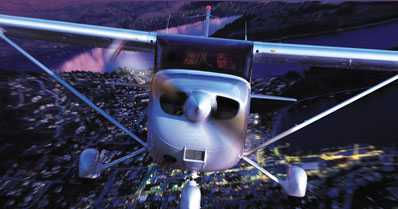
A witness reported that neither airplane appeared to alter its
course during the final seconds of flight. No airport facilities or
any of the pilots flying in the vicinity reported hearing any
communication from either airplane.
More News
Light Gun A handheld directional light signaling device which emits a brilliant narrow beam of white, green, or red light as selected by the tower controller. The color and type of>[...]
“We have performed extensive ground testing by comparing warm up times, full power tethered pulls, and overall temperatures in 100 degree environments against other aircraft >[...]
While Taxiing To Parking The Right Landing Gear Leg Collapsed, Resulting In Substantial Damage Analysis: The pilot made a normal approach with full flaps and landed on the runway. >[...]
From 2014 (YouTube Edition): Exotic Rebuild Reveals Aerial Work Of Art During EAA AirVenture 2014, ANN's Michael Maya Charles took the time to get a history lesson about a great ai>[...]
Also: Project Talon, McFarlane Acquisition, Sky-Tec Service, JPL Earth Helo Tests Bombardier has earned a round of applause from the business aviation community, celebrating the fo>[...]



 ANN's Daily Aero-Term (12.13.25): Light Gun


 See All