
X-15 Space Pioneers Now Honored As Astronauts | Aero-News Network
Aero-News Network
RSS icon RSS feed
podcast icon MP3 podcast
Subscribe Aero-News e-mail Newsletter Subscribe

Airborne Unlimited -- Most Recent Daily Episodes

Episode Date

Airborne-Monday

Airborne-Tuesday

Airborne-Wednesday Airborne-Thursday

Airborne-Friday

Airborne On YouTube

Airborne-Unlimited-12.22.25

AirborneNextGen-
12.23.25

Airborne-Unlimited-12.10.25

Airborne-FltTraining-12.18.25

AirborneUnlimited-12.19.25

AFE 2025 LIVE MOSAIC Town Hall (Archived): www.airborne-live.net

Wed, Aug 24, 2005

X-15 Space Pioneers Now Honored As Astronauts

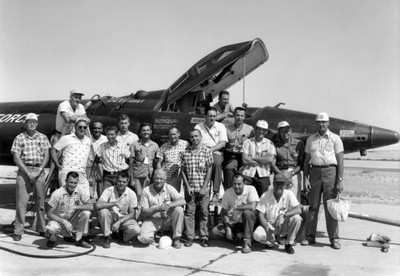
In a turbulent era of 1960s Cold War confrontations, moon race headlines, and war in southeast Asia, eight military and civilian test pilots flew the radical X-15 rocket plane out of the atmosphere and into the record books, earning astronaut status.

Until today, three of those early astronaut test pilots never received official recognition of their lofty membership as astronauts because only the military had astronaut wings to confer on their pilots at that time.

Civilian NASA pilots had no such badge.

That inequity was rectified today when retired NASA pilot Bill Dana, and family members representing deceased pilots John B. McKay and Joseph A. Walker, received civilian astronaut wings acknowledging their flights above 264,000 feet altitude -- 50 miles high. The men were honored in a quiet ceremony at NASA's Dryden Flight Research Center on Edwards Air Force Base in California, site of their achievements.

Bill Dana was philosophical about it: NASA pilots didn't wear wings anyway, and the concept of winning special wings was probably more crucial to a military pilot's career ladder, he explained.

Dana's first of two flights into space took him 58.13 miles above the Mojave Desert on Nov. 1, 1966 on a mission to collect micrometeorite samples, while also learning about issues of sky brightness at that height.

Joe Walker's third X-15 foray into space claimed the unofficial world altitude record of 354,200 feet, or 67.08 miles, on Aug. 22, 1963. Walker's unofficial record also marked the highest altitude to which the X-15 was ever flown.

John McKay attained 295,600 feet altitude, or 55.98 miles, on Sept. 28, 1965 during during a flight that investigated several research experiments.

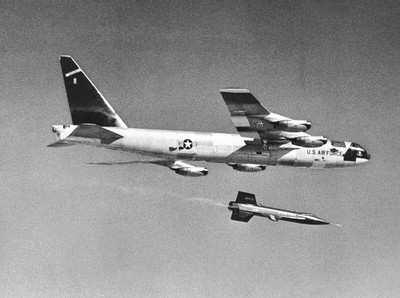
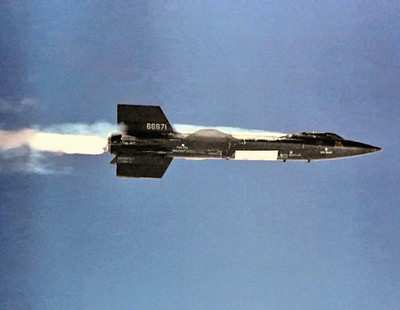
The X-15 program used three piloted hypersonic rocket planes to fly as high as 67 miles and as fast as nearly seven times the speed of sound. Volumes of test data gleaned from 199 X-15 missions from 1959 through 1968 helped shape the successful Mercury, Gemini, Apollo, and Space Shuttle human spaceflight programs. Two retired X-15s are displayed at the National Air and Space Museum, Washington, D.C., and the Air Force Museum, Dayton, Ohio.

FMI: www.nasa.gov, www.dfrc.nasa.gov

Advertisement

More News

Classic Aero-TV: In Praise of Alabama’s Patriot Aircraft USA

From 2023 (YouTube Edition): "Ain’t Your Daddy’s Super Cub”—Don Wade Co-owned by Don and Ron Wade—the former of Don’s Dream Machines, a storied >[...]

NTSB Final Report: Cirrus Design Corp SR22

Pilot-Rated Passenger Reported That The Pilot Did Not Adequately “Round Out” The Landing Flare And The Airplane Bounced And Yawed To The Right Analysis: The pilot state>[...]

ANN's Daily Aero-Term (12.21.25): Dead Reckoning

Dead Reckoning Dead reckoning, as applied to flying, is the navigation of an airplane solely by means of computations based on airspeed, course, heading, wind direction, and speed,>[...]

ANN's Daily Aero-Linx (12.21.25)

Aero Linx: Lake Amphibian Club This website is created and sponsored by the Lake Amphibian Club, to help spread the word about these wonderful, versatile amphibians that can land j>[...]

Aero-News: Quote of the Day (12.21.25)

“I am deeply honored to be sworn in as NASA administrator. NASA’s mission is as imperative and urgent as ever — to push the boundaries of human exploration, ignit>[...]

blog comments powered by Disqus



Advertisement

Advertisement

Podcasts

Advertisement

© 2007 - 2025 Web Development & Design by Pauli Systems, LC

