
GA-ASI Conducts First Flight Test From Upgraded FTTC | Aero-News Network
Aero-News Network
RSS icon RSS feed
podcast icon MP3 podcast
Subscribe Aero-News e-mail Newsletter Subscribe

Airborne Unlimited -- Most Recent Daily Episodes

Episode Date

Airborne-Monday

Airborne-Tuesday

Airborne-Wednesday Airborne-Thursday

Airborne-Friday

Airborne On YouTube

Airborne-SpecialEpisode-12.15.25

AirborneNextGen-
12.16.25

Airborne-Unlimited-12.10.25

Airborne-AffordableFlyers-12.11.25

AirborneUnlimited-12.12.25

AFE 2025 LIVE MOSAIC Town Hall (Archived): www.airborne-live.net

Fri, Sep 22, 2017

GA-ASI Conducts First Flight Test From Upgraded FTTC

Unmanned Flight Through Civil Airspace Covers 1,075 Nautical Miles

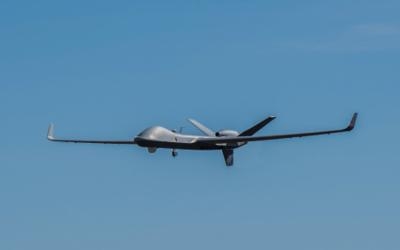
On August 30th, General Atomics Aeronautical Systems flew its first test flight out of its new Flight Test and Training Center (FTTC) facility in Grand Forks, North Dakota. The GA-ASI Block 5 Predator B/MQ-9 Remotely Piloted Aircraft (RPA) flew a round-trip of approximately 1,075 nautical miles. This was the longest transit flown by a Remotely Piloted Aircraft (RPA) in Class A civilian airspace under a Certificate of Waiver or Authorization (COA) granted by the FAA. The COA authorized the Block 5 MQ-9 to fly in airspace managed by air traffic controllers without the requirement of utilizing a “chase” airplane.

“This flight signified several ‘firsts’ for us and for the industry,” said David R. Alexander, president, Aircraft Systems, GA-ASI. “As we continue to demonstrate our ability to fly RPA safely alongside passenger planes, we further our efforts towards certifying the aircraft and increasing their mission possibilities in Class A civilian airspace.”

Additionally, this was the first time an unmanned aircraft operated through multiple spot beams of a High-throughput Satellite (HTS). HTS is a new generation of satellites providing higher data throughput and interference mitigation. As an RPA’s mission distance increases, it needs to be able to transition seamlessly from one satellite beam to another. For this flight, the Block 5 MQ-9 communicated with two HTS beams.

GA-ASI announced the completion of a new permanent hangar for its FTTC in Grand Forks on August 21st. The new hangar replaces the temporary facility that had been in operation since June 2016. It houses GA-ASI operational hardware, including RPA and ground control stations, as well as offices and conference rooms. In addition to conducting flight tests, the FTTC operation operates an office building near the University of North Dakota campus that features classrooms and a Predator Mission Aircrew Training System for accomplishing the academic and simulator segments of training.

(Image provided with General Atomics news release)

FMI: www.ga-asi.com

Advertisement

More News

Aero-News: Quote of the Day (12.18.25)

“These new aircraft strengthen our ability to respond quickly, train effectively and support communities nationwide. Textron Aviation has been a steadfast supporter in helpin>[...]

Classic Aero-TV: Viking Twin Otter 400--Bringing the DHC-6 Back Into Production

From 2011 (YouTube Edition): Rugged, Legendary, STOL Twin Makes A Comeback The de Havilland Twin Otter is an airplane with a long history, and it gained a reputation as a workhorse>[...]

NTSB Final Report: Rans Employee Flying Club Rans S-6ES Coyote II

A Wind Gust Lifted The Right Wing And The Airplane Turned To The Left Analysis: The pilot was departing from a 2,395-ft-long by 50-ft-wide turf runway. The pilot reported that afte>[...]

ANN FAQ: Submit a News Story!

Have A Story That NEEDS To Be Featured On Aero-News? Here’s How To Submit A Story To Our Team Some of the greatest new stories ANN has ever covered have been submitted by our>[...]

ANN's Daily Aero-Term (12.18.25): Braking Action Advisories

Braking Action Advisories When tower controllers receive runway braking action reports which include the terms “medium," “poor," or “nil," or whenever weather con>[...]

blog comments powered by Disqus



Advertisement

Advertisement

Podcasts

Advertisement

© 2007 - 2025 Web Development & Design by Pauli Systems, LC

