
MQ-8C Fire Scout To Undergo Electromagnetic Interference Tests | Aero-News Network
Aero-News Network
RSS icon RSS feed
podcast icon MP3 podcast
Subscribe Aero-News e-mail Newsletter Subscribe

Airborne Unlimited -- Most Recent Daily Episodes

Episode Date

Airborne-Monday

Airborne-Tuesday

Airborne-Wednesday Airborne-Thursday

Airborne-Friday

Airborne On YouTube

Airborne-Unlimited-12.01.25

AirborneNextGen-
12.02.25

Airborne-Unlimited-12.03.25

Airborne-FltTraining-12.04.25

AirborneUnlimited-12.05.25

AFE 2025 LIVE MOSAIC Town Hall (Archived): www.airborne-live.net

Wed, May 07, 2014

MQ-8C Fire Scout To Undergo Electromagnetic Interference Tests

Aircraft Being Prepped For Ship-Based Flights

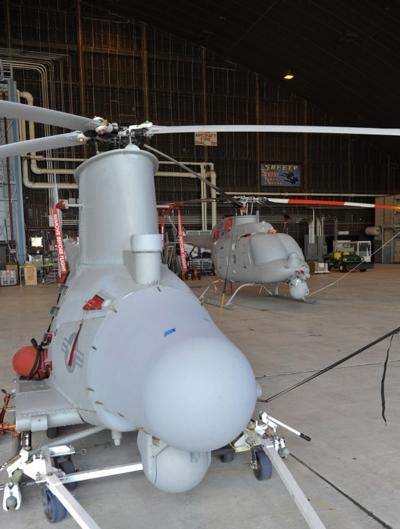
In preparation for ship-board flights this spring, the MQ-8C Fire Scout will be tested for its ability to operate safely in the intense electromagnetic environment aboard U.S. Navy ships. The MQ-8C Fire Scout uses specially-designed cages, known as Faraday cages, to protect sensitive equipment on the aircraft from signal interference.

"All Navy aircraft must go through electromagnetic interference testing to ensure they can operate safely in the ship environment," said Capt. Patrick Smith, Fire Scout program manager at Naval Air Systems Command. "We're confident that the design of the Faraday cages and other engineering work done on the MQ-8C Fire Scout will pass these tests."

The MQ-8C is based on a larger helicopter airframe and can fly almost twice as long and carry three times more intelligence-gathering sensor payloads than the MQ-8B variant.

During the program's design phase, a team of engineers created a new modular Faraday cage that protects electronic systems in flight. "Almost 95 percent of what makes up the MQ-8B variant is reused in the MQ-8C to save money and the time needed to conduct a test program. However, we took advantage of lessons learned to incorporate a more modern shielding device in the new aircraft," said George Vardoulakis, vice president, medium range tactical systems, Northrop Grumman.

The Faraday cages are built by Summit Aviation in Somerset, Kentucky, and installed during final assembly at Northrop Grumman's Unmanned Systems Center in Moss Point, MS.

Since first flight Oct. 31, the MQ-8C Fire Scout has flown 102 flights. The initial flight tests will validate that the autonomous control systems of the helicopter are working properly before its first ship-based demonstration.

(Image provided by Northrop Grumman)

FMI: www.northropgrumman.com

Advertisement

More News

ANN's Daily Aero-Term (12.04.25): Cooperative Surveillance

Cooperative Surveillance Any surveillance system, such as secondary surveillance radar (SSR), wide-area multilateration (WAM), or ADS-B, that is dependent upon the presence of cert>[...]

ANN's Daily Aero-Linx (12.04.25)

Aero Linx: OX5 Aviation Pioneers Incorporated in 1955 as a Pa 501 (c)(3) Not for Profit Corporation, the OX5 Aviation Pioneers is dedicated to bringing before the public the accomp>[...]

NTSB Prelim: Extra Flugzeugproduktions EA 300/SC

The Pilot Appeared To Regain Control After Six Rotations And Attempted To “Fly Out” Inverted But Had Insufficient Altitude On November 8, 2025, at 1038 eastern standard>[...]

Classic Aero-TV: The Bally Bomber - The All Time Ultimate Warbird Replica?

From 2018 (YouTube Edition): Aero-News Talks With The Airplane's Builder One of the many unique airplanes at AirVenture 2018 was a 1/3-scale B-17 bomber built by Jack Bally, who ta>[...]

ANN's Daily Aero-Linx (12.05.25)

Aero Linx: Society of U.S. Army Flight Surgeons (SoUSAFS) The Society of US Army Flight Surgeons (SoUSAFS) serves to advance the science and art of Aerospace Medicine and its allie>[...]

blog comments powered by Disqus



Advertisement

Advertisement

Podcasts

Advertisement

© 2007 - 2025 Web Development & Design by Pauli Systems, LC

