
USAF Report Indicates Microburst A Factor In C-130 Firefighting Accident | Aero-News Network
Aero-News Network
RSS icon RSS feed
podcast icon MP3 podcast
Subscribe Aero-News e-mail Newsletter Subscribe

Airborne Unlimited -- Most Recent Daily Episodes

Episode Date

Airborne-Monday

Airborne-Tuesday

Airborne-Wednesday Airborne-Thursday

Airborne-Friday

Airborne On YouTube

Airborne-Unlimited-12.08.25

AirborneNextGen-
12.09.25

Airborne-Unlimited-12.10.25

Airborne-AffordableFlyers-12.11.25

AirborneUnlimited-12.12.25

AFE 2025 LIVE MOSAIC Town Hall (Archived): www.airborne-live.net

Fri, Nov 16, 2012

USAF Report Indicates Microburst A Factor In C-130 Firefighting Accident

Crew Misjudged Wind Conditions While Flying In The South Dakota Black Hills

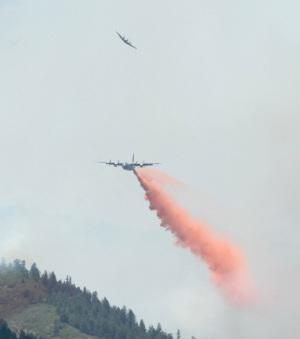
The crew of a MAFFS C-130 engaged in a firefight mission misjudged wind conditions and flew into the area of a microburst, which caused the airplane to impact the ground. That is the assessment of an Air Force accident panel investigating the crash.

The accident occurred July 1. In releasing an executive summary of the full report from the Air Force Mobility Command, Brig. Gen. Randall Guthrie said that the pilots' actions allowed two crewmembers in the back of the plane to survive the accident.

Stars and Stripes reports that the investigation found that that the C-130 Hercules tanker flew into a microburst just a few minutes after the pilot narrowly avoided an accident from another downdraft. Guthrie said that the crew had "struggled" to regain airspeed after their first drop of fire retardant, and the airplane encountered the microburst on the second run. He said that the prop from the number 4 engine struck the door near the back of the aircraft, and gave the loadmasters there an opportunity to escape. The four crewmen in the cockpit were killed instantly, Guthrie said.

The General said that the crew should have aborted the second run given the weather conditions, but added that they were not solely to blame for the accident. He said that a smaller lead plane did not adequately communicate the conditions to the MAFFS crew, but that considering that airplane had "barely escaped" impacting the ground, the lack of communications was "understandable." He also said that there was no ground control that could have provided a warning about weather conditions.

The full report has not been released. A safety investigation board will determine if any safety recommendations need to be made.

(USAF Image)

FMI: www.af.mil

Advertisement

More News

ANN's Daily Aero-Term (12.13.25): Light Gun

Light Gun A handheld directional light signaling device which emits a brilliant narrow beam of white, green, or red light as selected by the tower controller. The color and type of>[...]

Aero-News: Quote of the Day (12.13.25)

“We have performed extensive ground testing by comparing warm up times, full power tethered pulls, and overall temperatures in 100 degree environments against other aircraft >[...]

NTSB Final Report: Gippsland GA-8

While Taxiing To Parking The Right Landing Gear Leg Collapsed, Resulting In Substantial Damage Analysis: The pilot made a normal approach with full flaps and landed on the runway. >[...]

Classic Aero-TV: Historically Unique -- Marlin Horst's Exquisite Fairchild 71

From 2014 (YouTube Edition): Exotic Rebuild Reveals Aerial Work Of Art During EAA AirVenture 2014, ANN's Michael Maya Charles took the time to get a history lesson about a great ai>[...]

Airborne 12.12.25: Global 8000, Korea Pilot Honors, AV-30 Update

Also: Project Talon, McFarlane Acquisition, Sky-Tec Service, JPL Earth Helo Tests Bombardier has earned a round of applause from the business aviation community, celebrating the fo>[...]

blog comments powered by Disqus



Advertisement

Advertisement

Podcasts

Advertisement

© 2007 - 2025 Web Development & Design by Pauli Systems, LC

