
NTSB Releases Preliminary Report In Alaska Floatplane Accident | Aero-News Network
Aero-News Network
RSS icon RSS feed
podcast icon MP3 podcast
Subscribe Aero-News e-mail Newsletter Subscribe

Airborne Unlimited -- Most Recent Daily Episodes

Episode Date

Airborne-Monday

Airborne-Tuesday

Airborne-Wednesday Airborne-Thursday

Airborne-Friday

Airborne On YouTube

Airborne-SpecialEpisode-12.15.25

AirborneNextGen-
12.16.25

Airborne-Unlimited-12.10.25

Airborne-AffordableFlyers-12.11.25

AirborneUnlimited-12.12.25

AFE 2025 LIVE MOSAIC Town Hall (Archived): www.airborne-live.net

Mon, Aug 22, 2016

NTSB Releases Preliminary Report In Alaska Floatplane Accident

Pilot Said Aircraft Never Left The Water Before Impact

The NTSB has released a preliminary report from an accident involving a floatplane in Alaska August 8.

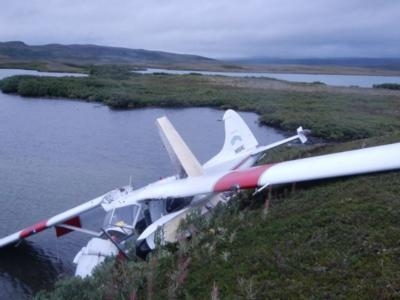
According to the report, a float-equipped de Havilland DHC-2 (Beaver) airplane, N95RC, sustained substantial damage when it impacted terrain during takeoff from Crosswind Lake, located about 38 miles south of Iliamna, Alaska. Of the seven people on board, the commercial pilot and three passengers sustained serious injuries, and three passengers sustained minor injuries.

The airplane was registered to, and operated by, Rapids Camp Lodge, Inc., King Salmon, Alaska, as a visual flight rules (VFR) other work-use flight, under the provisions of Title 14 Code of Federal Regulations (CFR) Part 91. Visual meteorological conditions prevailed at the time of the accident. The flight was originating at the time of the accident and was destined to King Salmon.

In a brief telephone conversation with the National Transportation Safety Board investigator-in-charge on August 9, the accident pilot stated that before starting his takeoff run, he back-taxied the airplane to the far north/northeast end of the lake in an attempt to use the full length of the lake for takeoff.

He said that during his takeoff run, the airplane did not become airborne before reaching the lake's south/southwest shoreline, and the airplane floats subsequently collided with an area of rising terrain on the shoreline. The airplane sustained substantial damage to the wings and fuselage.

(Source: NTSB. National Park Service image)

FMI: www.ntsb.gov

Advertisement

More News

Aero-News: Quote of the Day (12.18.25)

“These new aircraft strengthen our ability to respond quickly, train effectively and support communities nationwide. Textron Aviation has been a steadfast supporter in helpin>[...]

Classic Aero-TV: Viking Twin Otter 400--Bringing the DHC-6 Back Into Production

From 2011 (YouTube Edition): Rugged, Legendary, STOL Twin Makes A Comeback The de Havilland Twin Otter is an airplane with a long history, and it gained a reputation as a workhorse>[...]

NTSB Final Report: Rans Employee Flying Club Rans S-6ES Coyote II

A Wind Gust Lifted The Right Wing And The Airplane Turned To The Left Analysis: The pilot was departing from a 2,395-ft-long by 50-ft-wide turf runway. The pilot reported that afte>[...]

ANN FAQ: Submit a News Story!

Have A Story That NEEDS To Be Featured On Aero-News? Here’s How To Submit A Story To Our Team Some of the greatest new stories ANN has ever covered have been submitted by our>[...]

ANN's Daily Aero-Term (12.18.25): Braking Action Advisories

Braking Action Advisories When tower controllers receive runway braking action reports which include the terms “medium," “poor," or “nil," or whenever weather con>[...]

blog comments powered by Disqus



Advertisement

Advertisement

Podcasts

Advertisement

© 2007 - 2025 Web Development & Design by Pauli Systems, LC

