Mon, Jan 20, 2014
First Flights Come Just Weeks After FAA Designation
Just weeks after its designation as one of six federally-approved test sites for unmanned aircraft systems (UAS), Texas A&M University-Corpus Christi conducted several test flights over South Texas ranchland to continue research and training on the RS-16 unmanned aerial vehicle (UAV). The recent FAA test site designation, announced Dec. 30, is expected to bring other UAS researchers to the University’s Lone Star UAS Center to expand research on new applications and safe integration of unmanned aerial technology into the national airspace.
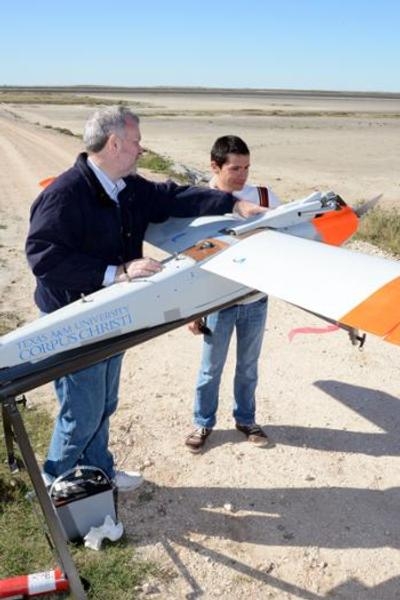
“For the last two years, we’ve been researching the best ways for using UAS applications – from helping monitor marine environments to tracking harmful pollutants over land and water,” said Dr. David Bridges, Director of the Unmanned Aircraft Systems Program. “Now that we’ve been named one of six FAA test sites, we are continuing our research and understanding of how to safely integrate unmanned aircraft into our national airspace.”
A&M-Corpus Christi has an established UAS program, including extensive airspace authorized by the FAA for UAS operations. The University also has established a UAS Command and Control Center at the Coastal Bend Business Innovation Center in Corpus Christi that will manage the 11 Texas test ranges. The University’s UAV, an RS-16, has participated in several missions since it arrived on campus in 2011.
While the test site designation does not come with federal funding, recent studies show an anticipated economic impact of $8 billion statewide, and $260 million in South Texas over the next 10 years; creating about 1,200 jobs.
During several flight missions this week, the aircraft launched from a mobile operations center, flew east out of sight of ground observers, and was monitored by a manned aircraft as it flew about seven miles out over Padre Island and the Gulf of Mexico. Regulations require the drone remain under visual contact at all times. Researchers also continued training with the onboard multi-spectral camera that acquired video, ultraviolet and thermal images that can be used for mapping sea grass, monitoring pipeline routes, detecting wildfires hotspots or oil spills in the ocean, and counting livestock. Researchers were able to do additional testing to eliminate radio frequency interference that may disrupt signals.
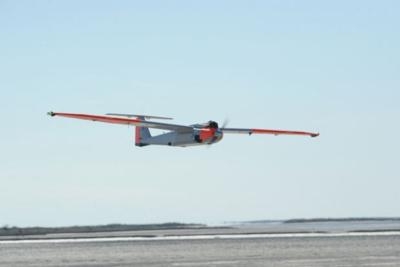
During the missions, a communications connection was established between the mobile operations at the ranch and Mission Control Center back in Corpus Christi. Command and Control researchers also continued development of the technology to track, monitor, and receive streaming video from the UAV and the launch site.
“We are fortunate to have extensive airspace along the Gulf and have collaboration with knowledgeable private-sector partners and government agencies,” said Dr. Frank Pezold, Dean of the College of Science and Engineering. “Our next step will be to utilize our expertise to become leading innovators in unmanned flight.”
The successful FAA test site bid was a team effort among A&M-Corpus Christi, Texas A&M Engineering Experiment Station (TEES), Camber Corporation, the University of Texas at Arlington Research Institute, the Southwest Research Institute (SWRI) in San Antonio, and other research institutions and private-sector companies.
(Images provided by Texas A&M)
More News
Cooperative Surveillance Any surveillance system, such as secondary surveillance radar (SSR), wide-area multilateration (WAM), or ADS-B, that is dependent upon the presence of cert>[...]
Aero Linx: OX5 Aviation Pioneers Incorporated in 1955 as a Pa 501 (c)(3) Not for Profit Corporation, the OX5 Aviation Pioneers is dedicated to bringing before the public the accomp>[...]
The Pilot Appeared To Regain Control After Six Rotations And Attempted To “Fly Out” Inverted But Had Insufficient Altitude On November 8, 2025, at 1038 eastern standard>[...]
From 2018 (YouTube Edition): Aero-News Talks With The Airplane's Builder One of the many unique airplanes at AirVenture 2018 was a 1/3-scale B-17 bomber built by Jack Bally, who ta>[...]
Aero Linx: Society of U.S. Army Flight Surgeons (SoUSAFS) The Society of US Army Flight Surgeons (SoUSAFS) serves to advance the science and art of Aerospace Medicine and its allie>[...]



 ANN's Daily Aero-Term (12.04.25): Cooperative Surveillance


 See All