

NASA, Industry Test Additively Manufactured Rocket Engine Injector | Aero-News Network
Aero-News Network
RSS icon RSS feed
podcast icon MP3 podcast
Subscribe Aero-News e-mail Newsletter Subscribe

Airborne Unlimited -- Most Recent Daily Episodes

Episode Date

Airborne-Monday

Airborne-Tuesday

Airborne-Wednesday Airborne-Thursday

Airborne-Friday

Airborne On YouTube

Airborne-Unlimited-12.08.25

AirborneNextGen-
12.09.25

Airborne-Unlimited-12.10.25

Airborne-AffordableFlyers-12.11.25

AirborneUnlimited-12.12.25

AFE 2025 LIVE MOSAIC Town Hall (Archived): www.airborne-live.net

Tue, Jul 16, 2013

NASA, Industry Test Additively Manufactured Rocket Engine Injector

Component Produced Through The '3-D Printing' Process

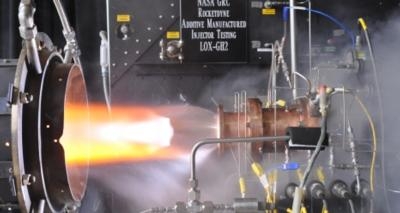
NASA and Aerojet Rocketdyne of West Palm Beach, FL, recently finished testing a rocket engine injector made through additive manufacturing, or 3-D printing. This space technology demonstration may lead to more efficient manufacturing of rocket engines, saving American companies time and money. NASA's Glenn Research Center in Cleveland conducted the successful tests for Aerojet Rocketdyne through a non-reimbursable Space Act Agreement.

A series of firings of a liquid oxygen and gaseous hydrogen rocket injector assembly demonstrated the ability to design, manufacture and test a highly critical rocket engine component using selective laser melting manufacturing technology. Aerojet Rocketdyne designed and fabricated the injector by a method that employs high-powered laser beams to melt and fuse fine metallic powders into three dimensional structures.

"NASA recognizes that on Earth and potentially in space, additive manufacturing can be game-changing for new mission opportunities, significantly reducing production time and cost by 'printing' tools, engine parts or even entire spacecraft," said Michael Gazarik, NASA's associate administrator for space technology in Washington. "3-D manufacturing offers opportunities to optimize the fit, form and delivery systems of materials that will enable our space missions while directly benefiting American businesses here on Earth."

This type of injector manufactured with traditional processes would take more than a year to make but with these new processes it can be produced in less than four months, with a 70 percent reduction in cost.

"Rocket engine components are complex machined pieces that require significant labor and time to produce. The injector is one of the most expensive components of an engine," said Tyler Hickman, who led the testing at Glenn.

Aerojet Rocketdyne's additive manufacturing program manager, Jeff Haynes, said the injector represents a significant advancement in application of additive manufacturing, most often used to make simple brackets and other less critical hardware. "The injector is the heart of a rocket engine and represents a large portion of the resulting cost of these systems. Today, we have the results of a fully additive manufactured rocket injector with a demonstration in a relevant environment." he said.

Glenn and Aerojet Rocketdyne partnered on the project with the Air Force Research Laboratory at Edwards Air Force Base, CA. At the Air Force lab, a unique high-pressure facility provided pre-test data early in the program to give insight into the spray patterns of additively manufactured injector elements.

"Hot fire testing the injector as part of a rocket engine is a significant accomplishment in maturing additive manufacturing for use in rocket engines," said Carol Tolbert, manager of the Manufacturing Innovation Project at Glenn. "These successful tests let us know that we are ready to move on to demonstrate the feasibility of developing full-size, additively manufactured parts."

(Image provided by NASA.)

FMI: www.nasa.gov/spacetech

Advertisement

More News

ANN's Daily Aero-Term (12.13.25): Light Gun

Light Gun A handheld directional light signaling device which emits a brilliant narrow beam of white, green, or red light as selected by the tower controller. The color and type of>[...]

Aero-News: Quote of the Day (12.13.25)

“We have performed extensive ground testing by comparing warm up times, full power tethered pulls, and overall temperatures in 100 degree environments against other aircraft >[...]

NTSB Final Report: Gippsland GA-8

While Taxiing To Parking The Right Landing Gear Leg Collapsed, Resulting In Substantial Damage Analysis: The pilot made a normal approach with full flaps and landed on the runway. >[...]

Classic Aero-TV: Historically Unique -- Marlin Horst's Exquisite Fairchild 71

From 2014 (YouTube Edition): Exotic Rebuild Reveals Aerial Work Of Art During EAA AirVenture 2014, ANN's Michael Maya Charles took the time to get a history lesson about a great ai>[...]

Airborne 12.12.25: Global 8000, Korea Pilot Honors, AV-30 Update

Also: Project Talon, McFarlane Acquisition, Sky-Tec Service, JPL Earth Helo Tests Bombardier has earned a round of applause from the business aviation community, celebrating the fo>[...]

blog comments powered by Disqus



Advertisement

Advertisement

Podcasts

Advertisement

© 2007 - 2025 Web Development & Design by Pauli Systems, LC

