Lockheed-Martin X-59; Meet Your Mach-er
Concorde made its last commercial flight on 24 October 2003, flying from New York to London at Mach 2.0—twice the speed of sound—in about 3.5-hours.
Twenty-years on, no commercial airliner has exceeded—or neared, for that matter—supersonic speed.
NASA, by dint of its Quesst mission, an ostensibly clever acronym connoting Quiet SuperSonic Technology, has set out to return supersonic flight to the purview of the world’s commercial airlines.
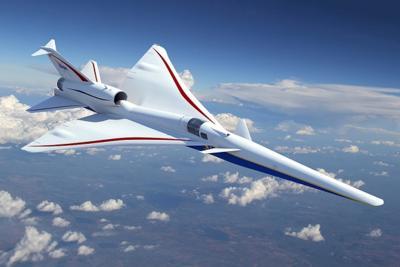
The program is predicated, in part, on Lockheed-Martin’s X-59 Quesst, an experimental supersonic aircraft being developed at the storied defense contractor’s famed Skunk Works. NASA intends to fly the X-59 over U.S. communities for purpose of identifying a set of sound-limits by which quiet supersonic flight will ultimately be defined.
NASA Quesst mission integration manager Peter Coen set forth the space agency plans to collect data supportive of a larger international effort to develop an enroute noise standard sufficiently quiet to not disturb persons on the ground. Utilizing data gleaned by virtue of the X-59, new decibel-based regulations governing supersonic flight over continental (land) regions will be developed and codified, thereby facilitating the emergence of new faster-than-sound commercial passenger and cargo markets.
The X-59’s design encompasses technologies that drastically reduce the loudness of the sonic-booms created by the aircraft—as perceived at the Earth’s surface. On 19 July 2023, in preparation for ground-testing, the X-59 was moved from a construction facility to the Skunk Works flight-line.
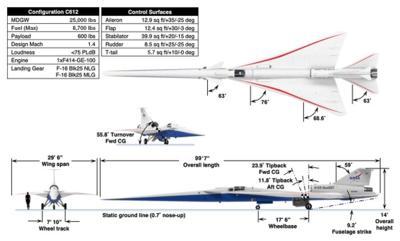
Lockheed-Martin’s X-59 Quesst is 99-feet, seven-inches in length and has a wingspan of only 29.5-feet. After the fashion of past Skunk Works creations, the X-59 comprises components and systems borrowed from other aircraft, to include a T-38F cockpit and ejection set, and landing-gear nicked from an F-16 Falcon.
In the aggregate, the X-59 is chock-full of five-hundred giblets lifted from donor-aircraft.
Loaded to its 32,000-pound maximum takeoff weight and propelled by a single 22,000-lbf. General Electric F414 afterburning turbofan engine, the X-59 will cruise at Mach 1.42 at FL550 and sprint to a Vne of Mach 1.5—so states Lockheed-Martin.
The GE F414 and variants thereof power Boeing’s F/A-18E/F Super Hornet and Saab’s JAS 39E/F Gripen.
Mr. Coen said of the X-59: “This will really allow us to take a major step forward and collect data.”
Acoustic validation of the X-59 is slated to begin in 2024, with community response testing to commence the following year.
The X-59’s development was not without difficulties. “Every little thing had to be modeled and tested,” Coen reported.
The cobbling together of hybrid aircraft is a notoriously fiddly business. The electrical systems of such machines are particularly predisposed to gremlin infestation—as was the X-59.
The aspect of the X-59’s long, sloping nose is such that pilot visibility is dramatically-restricted during takeoff and landing operations. Ergo, a synthetic vision system of sorts was devised.
“We developed an external vision system (XVS) with a camera mounted on the [X-59’s] nose and a high-definition display,” Coen explained. “It gives the pilot forward vision.”
Cockpit visibility was further improved by the addition of small side-facing windows to the X-59’s cockpit. Subject windows aid pilots in judging the touch-down attitude.
Tested aboard a Beechcraft King Air, the X-59’s XVS system proved eminently effective. “Almost better than the eyeball in hazy conditions,” Coen remarked. Moreover, the XVS can be enhanced with graphical fight data—similar to a conventional Head Up Display (HUD)—for takeoffs, approaches, and landings.



 Aero-FAQ: Dave Juwel's Aviation Marketing Stories -- ITBOA BNITBOB


 See All