
Raytheon Begins Flight Testing DARPA's PCAS Program | Aero-News Network
Aero-News Network
RSS icon RSS feed
podcast icon MP3 podcast
Subscribe Aero-News e-mail Newsletter Subscribe

Airborne Unlimited -- Most Recent Daily Episodes

Episode Date

Airborne-Monday

Airborne-Tuesday

Airborne-Wednesday Airborne-Thursday

Airborne-Friday

Airborne On YouTube

Airborne-Unlimited-12.08.25

AirborneNextGen-
12.09.25

Airborne-Unlimited-12.10.25

Airborne-FltTraining-12.04.25

AirborneUnlimited-12.05.25

AFE 2025 LIVE MOSAIC Town Hall (Archived): www.airborne-live.net

Mon, Nov 10, 2014

Raytheon Begins Flight Testing DARPA's PCAS Program

Persistent Close Air Support Designed To Speed Close Air Support To Ground Troops

Raytheon has begun flight testing DARPA's Persistent Close Air Support (PCAS) program. PCAS Phase 3 is an 18-month, $25.5 million effort scheduled to culminate in live-fire demonstrations. The program is designed to speed close air support to soldiers on the battlefield.

"PCAS will help reduce close air support response times from as long as one hour to just six minutes," said Tom Bussing, Raytheon vice president of Advanced Missile Systems. "By delivering critical information to decision makers more quickly, PCAS will save lives in the battlespace."

PCAS will enable ground troops, Joint Terminal Attack Controllers (JTACs) and combat aircrews to share real-time situational awareness and weapons systems data. With PCAS, soldiers on the battlefield can quickly and positively identify multiple targets simultaneously. JTACs and aircrews will jointly select the best precision-guided weapons for each target while minimizing collateral damage and friendly fire.

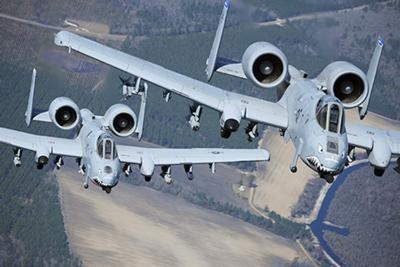
Current flight testing will highlight PCAS-air performance on an A-10 Thunderbolt aircraft and connectivity with the JTAC equipped with a PCAS-ground kit. The key element of PCAS-air is modular smart launcher electronics, which can be easily ported from one platform to another.

Once flight testing is complete, the PCAS system will be available for integration with other aircraft and participation in other demonstrations. Digital interoperability between platforms and JTACs will allow for increased situational awareness, improved coordination, and decreased timelines for close air support.

Raytheon is the systems integrator for PCAS and leads an industry team comprised of Rockwell Collins, General Electric, BAE Systems and 5-D Systems. Raytheon brings its expertise in overall systems integration, weapons, aircraft integration and unmanned aircraft system ground control stations to PCAS.

(A-10 Thunderbolt image from file)

FMI: www.raytheon.com

Advertisement

More News

ANN's Daily Aero-Term (12.08.25): Decision Altitude (DA)

Decision Altitude (DA) A specified altitude (mean sea level (MSL)) on an instrument approach procedure (ILS, GLS, vertically guided RNAV) at which the pilot must decide whether to >[...]

ANN's Daily Aero-Linx (12.08.25)

Aero Linx: T-34 Association, Inc. The T-34 Association was formed in July 1975 so that individuals purchasing then military surplus T-34As had an organization which would provide s>[...]

NTSB Final Report: Piper PA-31T3

As He Released The Brakes To Begin Taxiing, The Brake Pedals Went To The Floor With No Braking Action Analysis: The pilot reported that during engine start up, he applied the brake>[...]

Aero-News: Quote of the Day (12.08.25)

“Legislation like the Mental Health in Aviation Act is still imperative to hold the FAA accountable for the changes they clearly acknowledge need to be made... We cannot wait>[...]

Airborne-Flight Training 12.04.25: Ldg Fee Danger, Av Mental Health, PC-7 MKX

Also: IAE Acquires Diamond Trainers, Army Drones, FedEx Pilots Warning, DA62 MPP To Dresden Tech Uni The danger to the flight training industry and our future pilots is clear. Dona>[...]

blog comments powered by Disqus



Advertisement

Advertisement

Podcasts

Advertisement

© 2007 - 2025 Web Development & Design by Pauli Systems, LC

