Global Warming? How About Universal Warming
During a period of universal warming 11 billion years ago,
quasars - the brilliant core of active galaxies - produced fierce
radiation blasts that stunted the growth of some dwarf galaxies for
approximately 500 million years. This important conclusion comes
from a team of astronomers that used the new capabilities of NASA's
Hubble Space Telescope to probe the invisible, remote universe. The
team's results will be published in the October 10 issue of The
Astrophysical Journal.
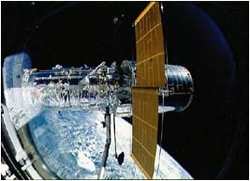
Hubble Telescope NASA Image
Using Hubble's Cosmic Origins Spectrograph (COS), the
astronomers identified this era, from 11.7 to 11.3 billion years
ago, when the ultraviolet light emitted by active galaxies stripped
electrons off helium atoms. The process, known as ionization,
heated the intergalactic helium from 18,000 degrees Fahrenheit to
nearly 40,000 degrees. This inhibited the gas from gravitationally
collapsing to form new generations of stars in some small
galaxies.
Because of its greatly improved sensitivity and lower background
"noise" compared to previous spectrographs in space, the COS
observations were ground-breaking. The observations allowed
scientists to produce more detailed measurements of the
intergalactic helium than previously possible. "These COS results
yield new insight into an important phase in the history of our
universe," said Hubble Program Scientist Eric Smith at NASA
Headquarters in Washington.
Michael Shull of the University of Colorado in Boulder and his
team studied the spectrum of ultraviolet light produced by a quasar
and found signs of ionized helium. This beacon, like a headlight
shining through fog, travels through interspersed clouds of
otherwise invisible gas and allows for a core sample of the gas
clouds.
The universe went through an initial heat wave more than 13
billion years ago when energy from early massive stars ionized cold
interstellar hydrogen from the big bang. This epoch is called
reionization, because the hydrogen nuclei originally were in an
ionized state shortly after the big bang.
The Hubble team found it would take another two billion years
before the universe produced sources of ultraviolet radiation with
enough energy to reionize the primordial helium that also was
cooked up in the big bang. This radiation didn't come from stars,
but rather from super massive black holes. The black holes
furiously converted some of the gravitational energy of this mass
to powerful ultraviolet radiation that blazed out of these active
galaxies.
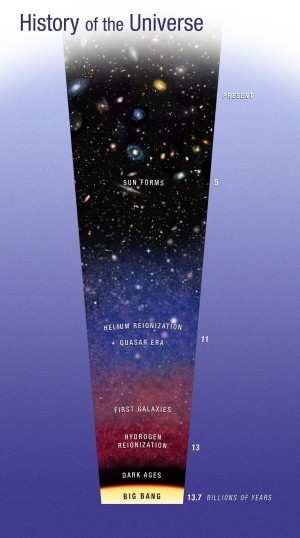
History Of The Universe NASA Image
The helium's reionization occurred at a transitional time in the
universe's history when galaxies collided to ignite quasars. After
the helium was reionized, intergalactic gas again cooled down and
dwarf galaxies could resume normal assembly. "I imagine quite a few
more dwarf galaxies may have formed if helium reionization had not
taken place," Shull said.
So far, Shull and his team only have one perspective to measure
the helium transition to its ionized state. However, the COS
science team plans to use Hubble to look in other directions to
determine if helium reionization uniformly took place across the
universe.



 ANN's Daily Aero-Term (12.08.25): Decision Altitude (DA)


 See All