

Sat, Sep 16, 2023
The Past and Future of High-Speed Flight
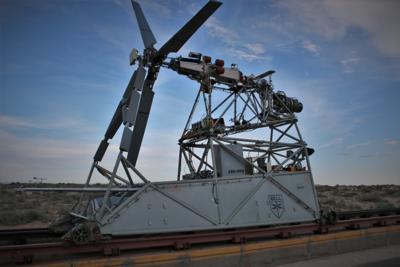
Bell Textron Inc. has delivered a High-Speed Vertical Takeoff and Landing (HSVTOL) test-article to Holloman Air Force Base for demonstration and technology evaluation. Testing teams will leverage the Arnold Engineering Development Complex Holloman High Speed Test Track for purpose of vetting the test-article’s folding-rotor, integrated-propulsion, and flight control technologies at speeds representative of actual flight.

Bell executive vice-president of engineering Jason Hurst stated: “The HSVTOL test-article delivery and start of sled-testing operations serves as a major milestone in our mission to develop the next generation of high-speed vertical lift aircraft. Bell plans to showcase HSVTOL technology informed by more than 85-years of high-speed rotorcraft development and leverage lessons learned to produce a flying prototype with game-changing capabilities.”
Bell, by dint of the forthcoming sled-test regimen, seeks to validate key technologies by way of a full-scale, integrated demonstration in a representative operating environment. Bell plans for the test-article to execute a series of HSVTOL high-speed transition maneuvers—a first-of-its-kind capability for vertical lift aircraft. Prior to the HSVTOL test-article’s delivery to Holloman Air Force Base, Bell successfully completed functional demonstrations of the contraption at the company’s Flight Research Center.

Bell’s High-Speed Vertical Takeoff and Landing (HSVTOL) technology amalgamates the hover capability of a conventional helicopter with the speed (four-hundred-plus-knots), range, and survivability of a fixed-wing jet aircraft. Bell has developed high-speed vertical lift technology for more than 85-years, pioneering innovative VTOL configurations such as the X-14, X-22, XV-3, and XV-15 for customers the likes of NASA, the U.S. Army. and U.S. Air Force. The antecedent vehicles build on Bell’s proven history of high-speed flight, which extends back to the Bell X-1—the storied rocket-powered experimental aircraft in which then Captain Charles “Chuck” Yeager made the world’s first manned supersonic flight on 14 October 1947.
More News
Waypoint A predetermined geographical position used for route/instrument approach definition, progress reports, published VFR routes, visual reporting points or points for transiti>[...]
Aero Linx: Sentimental Journey to Cub Haven Sentimental Journey Flyin began in 1986 with a group of dedicated volunteers working to provide a sentimental return to Lock Haven, the >[...]
The Pilot Would Often Fly Over Their House At A Low Altitude And That Family Members Would Go Outside To Wave On November 14, 2025, at 1708 eastern standard time, a Jabiru USA Spor>[...]
From 2024 (YouTube Edition): Volatus Infrastructure Paves The Way The name “Volatus” seems to be everywhere these days, popping up in a series of partnerships and proje>[...]
Fortnite Conquers All, Klyde FMI: www.klydemorris.com>[...]


